Showing posts with label Nifong. Show all posts

Friday, September 07, 2007

A Special Message from Flash to Inmate Nifong


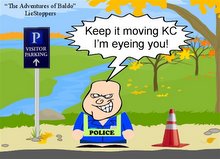
Flash is one of the members of LieStoppers. Some of you might remember him from Court TV Message Boards? When times were glum, Flash was always there to get our spirits up. We all love him dearly. He is concerned about Nifong in jail wearing his orange jumpsuit and has this special message for him.
"Don't drop the soap!"

Friday, August 31, 2007

GUILTY


Disgraced, disbarred, and former Durham DA Nifong was found guilty today of being in criminal contempt of the court. Judge Smith made his ruling after two days of hearings. The evidence was clear, Nifong withheld exculpatory DNA for months while he prosecuted three innocent Lacrosse players over a crime that did not happen.

Nifong has lost his job, his license to practice law, and now his freedom. Judge Smith sentenced him to appear to carry out his sentence beginning 9 a.m. Friday, Sept. 7. He will be serving one day.

While LieStoppers is disappointed that Judge Smith gave him a minimum sentence we relish the thought of the Nifong Perp Walk.

What's next for Nifong? Rumours of a lawsuit are swirling in Durham and Nifong is sure to be front and center in any litigation.

Hat Tip to St. Raymond

Feast day of St. Raymond Nonnatus

Whether one believes in the saints and religion is a personal matter. However, the irony that the last day of Mike Nifong’s criminal contempt of court hearing falls on Saint Raymond Nonnatus' Feast Day is fitting. Saint Raymond is Patron Saint of the Falsely Accused.

The Evan’s family took great solace in St. Raymond during the long ordeal they and the other two families went through. Joan Collins wrote this article concerning Faith and the Duke Lacrosse Case on FODU.

Thursday, August 16, 2007

Wednesday, August 15, 2007

"Deja vu all over again"

Disgraced, disbarred, and former Durham DA Michael Bryon Nifong has finally tendered his law license eight weeks after he was disbarred on June 16th. True to his strategy throughout the Duke Lacrosse Case he has again made unsubstantiated allegations against an unnamed suspect.

In a letter to Ms Dottie Miani of the North Carolina State Bar dated 7 Aug, he claimed the poor shape of his law license was due to a puppy who chewed on it.

"..You will note that it contains a misspelling of my middle name (which I unfortunately did not notice until after my swearing in) and damage subsequently inflicted by a puppy in her chewing stage. Consequently, it has never been framed or displayed..."

Word quickly spread throughout the community to canine lovers to keep their dogs off the streets. Chief Chalmers could not be reached but the Durham PD promised to investigate the matter fully and has assigned their best District II investigators. Sergeant "No Notes" Gottlieb’s EZ Dry Erase board was wiped clean in preparation and "With What" Himan promised he would buy some film.

Cab driver Moezeldin Almostafa was warned against taking any fares to the Durham Animal Protection Society.

Manju, Sam, Serena, and Rann were busy in organizing meetings.

There was no comment from Duke University.

(Hat Tip to Mr. Yogi Berra)

Tuesday, June 26, 2007

Excerpts From Mike Nifong's State Bar Deposition, Part 4: Jackie Lopez, Officer of the Court - Reading the SANE Report, or not - Condoms

DIRECT EXAMINATION BY MR. BROCKER:

Q. Do you remember anything in that -- you said you didn't -- you talked about the officers, the impression you got from the officers. Did they talk to you about, regardless of the language they used, that Ms. Pittman had indicated that she didn't think an assault had happened?

A. I don't remember that having come up at that meeting. I mean, I obviously was aware at some point fairly early on that there were discrepancies between what Ms. Pittman said and what Ms. Mangum said, and that there were discrepancies between certain accounts that had been reported by Ms. Mangum, but I don't believe any of that came up at that first meeting.

Q. Okay. Can you give me a general time frame as to when you would have become aware of those things?

A. Within the -- within the first two or three weeks that I had the case probably, I would think. Not necessarily that first week, that was a pretty busy week. But at some point I remember that I asked the question of the officers, the 9-1-1 call that came in, do we believe that that was actually made by somebody, one of the people who was at the party, one of the dancers at the party. And they told me yes.And that was something that I asked because, you know, someone had asked me, some reporter had asked me, and it was something I'd never thought about and I had no clue. I had to tell them that I did not know who it was. And then I asked the officers and they said that they had understood that Kim Pittman had made the call.

Q. Did you ask the officers to see any of the documentation that they had accumulated up to that point at that meeting?

A. I don't believe so. I don't believe that I did at the 27th meeting.

Q. You talked about the first media coming in to talk to you a little after noon on that same day?

A. Yes, sir.

Q. Is that something that had been scheduled before the meeting with the officers or was it scheduled after?

A. No, sir. It was something that after -- I was meeting with the officers, and at some point got a call from my receptionist indicating that there were reporters out here that wanted to talk to me about this case. And I told them that I would, you know, I basically gave them a time frame when I would see somebody and said, who's out there, and I prettymuch put them in order that they came and then tried to speak With them.

Q. Did you have any indication before you met with the officers on the 27th there would be any people there to speak with you on that day or somewhere after?

A. I didn't have any indication, but that would have been -- my expectation would have been that it would have been Monday morning that the Non-Testimonial would have been discovered by the news media, and I anticipated that pretty quickly after that they would be trying to talk to me about it, which is why I had wanted to speak with the officers that morning before anybody had a chance to talk to me.

Q. Okay. I want to ask you about a number of documents, investigatory-type documents and try to get your best recollection as to when you would have seen those or been provided them. If you'll look -- the first one I want to ask you about is the -- I think it's Exhibit 11. We might not have them.

(Recess - 11:17 AM to 11:23 AM)

Q. Do you recognize Exhibit 11 as the sexual assault exam report from the SANE nurse at Duke?

A. Yes, sir, I do.

Q. And that was obtained on March 21st, 2006, it looks like from return service?

A. It does appear that that was the case.

Q. Okay.

A. I was not involved in the direct subpoena of this. And the person who got subpoenaed, Jackie Lopez, at the time was one of the people who worked in the Protection of the Family Unit and they dealt with the cases like this. She would have been the person who when there was an indication they needed to do this, Investigator Himan would have contacted her and she would have generated the subpoena, and then there is -- my signature is on our computer, so it can be generated that way onto the subpoenas themselves, So I don't actually see these documents when they go out. But that's what I would have expected to happen in the office because she or another -- I think she dealt probably with the felony cases. We have two victim-witness legal assistants in that unit, and I would have expected that one of them would have been the one who issued this. That would just reflect that Tracey cline had been contacted.

Q. You did -- you said you did not get any documentation at that March 27th meeting. When wouldyou have actually received or when did you receive this sexual assault report?

A. Well, I didn't receive it all at the same time. I guess the first thing I would say is that the parts of the sexual assault exam report that would be attached to the rape kit, which are, I guess, 541 through probably 550 would have been all that I would have seen initially, and it would not have been until sometime later that the parts 537 through 540, which was the narrative, I didn't see that right away. What I saw at first was the stuff from the actual collection from the rape samples. And I would have seen those, and that would have been shown to me by Mark Gottlieb, I would imagine, but it could have been Ben Himan, but I think probably Mark Gottlieb would have been the one that actually showed them to me. And I don't recall anybody ever specifically showing me the other pages, although they would have -- I mean, like looking bring them to me to look at. They would have been in the materials that when the police report -- a big box containing many folders was brought over for copying for discovery purposes, and I probably did not see those pages by that time.

Q. Okay. So when -- when would you have seen -- let me make sure I understand before we go on. When you said you were initially provided the report, would you say you got pages, what's handwritten down there 542 to 551 or to 550?

A. It would have been through 551, I believe. The stuff that was taken, that was collected, in connection with the sexual assault exam, the things with the rape kit and all, I would have seen that initially. I don't specifically recall having seen, say, for instance, Page 546. But I do specifically recall having seen Pages 542, 3, 4, and I have also seen -- I recall seeing Page 548, 549 and 550 and 551. So those pages, I recall specifically some of those pages, and I can't say specifically that I recall every page. And that would have been some time within the first two or three weeks of this having come to my attention.

Q. Do you have a specific recollection as to when or what date you would have first seen that report?

A. Not specifically, no, sir.

Q. Do you recall making statements to the news media during the first week, the week of March 27th, that you had reviewed or read the sexual assault report?

A. Yes, I believe that I did make -- I believe that I made such a statement during that first week.

Q. And so, would you have actually read it or reviewed it at that point?

A. I would not have reviewed the entire thing, like I said, but I would have seen at least part of it. And you said Sergeant Gottlieb brought that to you?

A. Yes, sir, I believe that he did. The thing I say is I don't recall seeing just Gottlieb at any one time, but usually Gottlieb and Ben Himan would come together during this period of time. And I don't specifically recall any times when only one of them came, but it is possible, because I knew Mark prior to this time and did not know Ben prior to this time. Usually the person who initiated the conversations with me would be Mark. So when they came over, he would usually be the one who was talking, which is why I say he probably gave it to me.

Q. So, just to make sure I am clear on it, sometime during the week of March 27th, you would have seen or reviewed the pages of Exhibit 11, numbered 542 through 551, which is what was actually in the rape kit?

A. I'm sorry, I wasn't sure.

Q. No, that's okay. I just was asking whether during the week of March 27th you reviewed the Exhibit 11, pages, the handwritten pages, 542 through 551?

A. I believe that is probably the case. I can't say with perfect certainty that I saw it on that specific date, but I think that was probably the case.

Q. But if you were making statements to the news media that you had read the report, at least by that time, you would have reviewed those pages of the report?

A. I would have at least -- I would have at least seen those pages, yes. I would have at least, you know, seen something from that.

Q. And you don't believe that you initially got or reviewed the handwritten portions of the sexual assault report, which is 537 through 540?

A. Yes, sir, I believe that is correct. I did not initially see those.

Q. Do you know why you didn't get the whole -- why you didn't look or didn't get the whole thing? A. No, sir.

Q. Were they done -- during the standard procedure, are these done simultaneously or is this typically done ---

A. Well, the part that goes into the rape kit is what I usually see. I don't -- I don't know why, I mean, maybe is that I just didn't ask for enough stuff when I -- if I didn't see everything. There's no way for me to say why I was only given certain pages and not others. Maybe Sergeant Gottlieb didn't have all of these pages. All I know is that I don't believe that I saw this -- I certainly did not read this narrative in here during that first week.

Q. All right. If you will look on Page 551, the last page?

A. Yes, sir.

Q. That is one of the pages that you would have had access to?

A. Yes, sir.

Q. And on that under Roman Numeral I, Arabic 1 there, it says, "Brief account of the assault." Do you see that?

A. Yes, sir.

Q. And it says, "patient sexually assaulted by three men at party. Persons unknown. Vaginally, erectally and orally assaulted. No condoms used."

A. Yes, sir.

Q. And then down on 11, it says, "Was a condom used?"And there's a box for "yes" and "no" and "not sure," and the person who filled this out had checked, "no," on that? Yes, sir.

Q.Do you recall whether you reviewed the entire report during the week of the 27th?
A.The entire report, meaning?

Q.The pages that you've already said that you were provided by Sergeant Gottlieb, Pages 542 through 551?

A.I'm not sure that I understand. When you say, "I reviewed it," did I -- if you're asking did I carefully read every word on these pages, I can't say that I did.

Q.Did you get a copy of the report or were you just shown it and read it and give it back?

A.It was in Gottlieb's possession. I did not get a copy at that time. The first time that I had a copy, I believe, was when Sergeant -- Investigator Himan brought over all of the files for copying for discovery purposes, which would have been after the indictment or sometime after.

Q. Sometime after April 18th -- April 17th?

A. Yes, sir. Well, actually I say after -- yeah, we didn't complete the discovery at that time until we actually turned it over on May the 18th. So sometime between that date and May the 18th is when it was turned over would have been when I actually had my own copy.

Q. Did you ever request that they bring you copies of the documentation prior to that?

A. I don't recall.

Q. You would agree this assault report, exam report, is a relatively important document in this prosecution; is that a fair statement?

A. Yes, sir. I think in terms of prosecution absolutely. Yes, sir.

Q. Were you aware during that first week, the week of the 27th, that Ms. Mangum had claimed that no condoms had been used during the assault?

A. I don't specifically recall, but I was probably aware of that. But I can't say that I recall reading that statement, but I certainly had access to those, so I probably was aware that she had said that.Q. Did you read -- we talked about what was
on Page 51, did you actually read that page that week?

A. Again, I probably did. I cannot say specifically that I did. I was -- I recall being particularly interested in the diagram, which is Page 544, and the description of, you know, where she felt injuries and soreness and things of that nature. I was looking at that.

Q. The -- by the week -- by the 27th of March, the Non-Testimonial Order had already been obtained and the samples had been obtained from all the lacrosse players?

A. Yes, sir.

Q. Wouldn't it have been an important fact, even at that stage since you were seeking DNA evidence, about whether or not a condom may have been used in the attack or not?

A. Well, I don't know really how to answer that question. obviously, it is something that's got to be dealt with at trial. My experience is that victims don't always know if a condom is used. And about the only way that a victim could know if a condom was used would be to see somebody actually put one on. So if a victim says that no condom was used, I usually take that to mean that she did not see the assailant put a condom on.

Q.What experience is that based on, that conclusion?

A.Well, generally speaking, I have -- when I have dealt with rape victims in the past, you know, did he use a condom? Well, I don't think so. You know, why did you -- well, I didn't see him put one on. And that's the kind of response that I usually get when I talk to victims like that. Sometimes they do see a condom put on. Generally speaking, the condom, when condoms are used, it's my experience it's more often to be in a date rape kind of situation. But there's certainly no absolute it's always this way one way or the other.

Q.Do you remember when you would have seen the remainder of Exhibit 11, the handwritten portion from Nurse Levicy?

A.Not specifically

Q.Do you know if you got it before the indictments, first set of indictments, on April 17th?

A.I don't know. I know that I would have gotten it by the time, you know, May 18th, which was the second indictment and the first discovery, but I can't say that I got it before the 17th

Monday, June 25, 2007

Gottlieb Confesses

The deposition of Durham Police Department Sergeant Mark Gottlieb, the supervisor of the Nifong/Mangum Hoax “investigation,” offers the clearest indication to date that the Grand Jury was intentionally manipulated and deceived into bringing indictments against three innocent men for invented crimes. Gottlieb’s sworn statement is tantamount to a confession to obstruction of justice and perjury. In describing his testimony to the Grand Jury, Sgt. Gottlieb admits that he stated, falsely, that Crystal Mangum offered a consistent story from her March 14 SANE examination onward.

Sgt. Gottlieb described his testimony to the Grand Jury as follows:
I told the facts of what's documented in my report. I talked about the way Ms. Mangum presented herself at her home, what she told us, what was found at the search warrant at the residence. I explained how these people had come down to the station and given their statements. I pointed out what was again found at the search warrant. I spoke to them about the time cards issues. I talked to them about the PowerPoint presentation. And they asked me about the medical report. I told them that the SANE nurse found the information to be consistent with the story she was giving. I explained to them that there were inconsistencies in the very beginning when she was crying, upset, whatever. But as soon as Nurse Levicy was able to calm her down, which didn't take long at all, she never changed her story from that point. I hope that covers in all.
Sgt. Gottlieb's description of his Grand Jury testimony is reminiscent of the bizarre explanation given by DPD Chief Steve Chalmers following his widely ridiculed "report" on the department's complicity in the Hoax. In response to Chalmer's similar attempt to suggest that the false accuser was a credible and consistent witness prior to the Grand Jury deception, we noted:
In an interview with the Herald-Sun's Ray Gronberg, the truth-challenged Chalmers asked the public to join him in the Twilight Zone by incredibly claiming:
“The only information we had was the information that we had gotten from [Crystal Magnum]… and at the point we did go into the grand jury, [Mangum’s] accounts were consistent up to that point.”
In reality, the false accuser's credibility and consistency were so lacking that Attorney General Cooper took the unprecedented step of publicly declaring the three Duke defendants "innocent" victims of a "rogue prosecutor". It defies logic and sanity for Chalmers to now attempt to resurrect the Hoax in the immediate aftermath of Cooper's unambiguous statements debunking the Credible Accuser Hoax. In the question and answer session that followed Cooper's April 11 announcement and in his Summary of Conclusions, the AG spoke of why the false accuser was never credible, nor were her stories ever consistent.

In his Declaration of Innocence, Cooper stated:
Based on the significant inconsistencies between the evidence and the various accounts given by the accusing witness, we believe these three individuals are innocent of these charges.

We approached this case with the understanding that rape and sexual assault victims often have some inconsistencies in their accounts of a traumatic event. However, in this case, the inconsistencies were so significant and so contrary to the evidence that we have no credible evidence that an attack occurred in that house that night.

...the contradictions in her many versions of what occurred and the conflicts between what she said occurred and other evidence, like photographs and phone records, could not be rectified.

... No DNA confirms the accuser's story. No other witness confirms her story. Other evidence contradicts her story. She contradicts herself.

During the Question and Answer session that followed, Cooper revealed:

...she's told many stories. Some things are consistent within those stories, but there were many stories that were told.

...Our investigators who talked with her and the attorneys who talked with her over a period of time think that she may actually believe the many different stories that she has been telling.

...I think that they believed the belief occurred as she was telling these things. And they don't know, but they've worked real hard with her, but it just doesn't make sense. You can't piece it together.

In his Summary of Conclusions, Cooper states:

The State’s cases rested primarily on a witness whose recollection of the facts of the allegations was imprecise and contradictory.

The accusing witness’s testimony regarding the alleged assault would have been contradicted by other evidence in the case from numerous sources

The accusing witness’s testimony regarding the alleged assault and the events leading up to and following the allegations would have been contradicted by significantly different versions of events she told over the past year

No testimony or physical evidence would have corroborated her testimony

Credible and verifiable evidence demonstrated that the accused individuals could not have participated in an attack during the time it was alleged to have occurred

The accusing witness’s credibility would have been suspect based on previous encounters with law enforcement, her medical history and inconsistencies within her statements

While some of Cooper's statements are based on continued contradictions and inconsistencies from the false accuser that followed the Durham Police Department's misleading grand jury testimony in April and May, the Attorney General showed that many of the obvious misrepresentations predate the grand jury deception and were in police reports, or uncovered through means available to Chalmers' investigators.

At the time of Chalmer's effort to spin the false accuser as credible and consistent, we also noted that his was not the first attempt to dupe the public with the Credible Accuser Hoax Within the Hoax.
Cooper's statements were not nearly the first indication that the false accuser was not credible or that her statements were inconsistent and untrue. Likewise, Chalmers' ridiculous effort to pretend otherwise is not the initial attempt by the Hoax conspirators to perpetuate the Credible Accuser Hoax.

...

In response to the revelations contained within the Bowen-Chambers report, City Manager Patrick Baker enabled the Credible Accuser Hoax by allegedly first ensuring that all police officers who had dealt with the false accuser had their stories straight and then falsely stating publicly that the pseudo-victim had never changed her story.

In one motion, defense attorney Kirk Osborn, who represents lacrosse player Reade Seligamann, asks that the Durham Police Department turn over all notes, tapes and information relating to the case to the Durham County District Attorney's office.

The court document says attorneys are concerned because Durham City Manager Patrick Baker has been interviewing police officers and may have pressured them to "get their stories straight."

Osborn, told WRAL on Monday that he was very concerned by Baker's actions, that they were unusual, and that he wanted to make sure the evidence is preserved.

Baker, during Durham's City Council meeting on Monday night, denied the assertion.

"I'm not asking them to get their stories straight at all," Baker said. "Certainly, as the chief executive officer of this organization, I feel like it's my duty to this Council and this community to make sure I'm in touch with what's going on."

Talked [sic] about the court filing at the City Council meeting, he said he interviewed officers after a Duke University report came out saying they had not taken the alleged victim's rape allegations seriously in the beginning. WRAL

Baker said he has never received any indication that the woman said she was raped by 20 men or that she changed her story.

"I have no idea where that came from," Baker said. "I've had a lot of conversations with the investigators in this case and with officials at Duke, and at no time did anyone indicate the accuser changed her story. If that were true, I'm sure someone would have mentioned it to me." News & Observer

Last June, defense attorney Joe Cheshire revealed that Durham police reports confirmed the assertions made in the Bowen-Chambers report, contradicting Baker's earlier denials. At a press conference following the June 22 hearing, Durham County District Attorney Mike Nifong's newly promoted Chief Investigator, Linwood "The Fixer" Wilson, interrupted Cheshire in an attempt to promote the Credible Accuser Hoax. Speaking to the press later that day, Wilson claimed to have read all of the discovery documents and stated boldly, but falsely, that the accuser had never changed her story.

And in a truly extraordinary development, even for a case as botched as this one: yesterday, defense attorney Joseph Cheshire gave a press conference stating that the newly turned-over documents contained another version of events from the accuser, this one claiming she was raped by five players, not three; and that there were four dancers at the party, not two. Cheshire was interrupted by Nifong's chief investigator, who informed the press that Cheshire was lying. The investigator, Linwood Wilson, then gave interviews to local and national media members stating, according to a Raleigh TV station, "that he personally read all 1814 pages of discovery documents and has not read that the alleged victim changed her version of the story." HNN

A bitter exchange that [sic] started outside of the courtroom when Linwood Wilson, an investigator for the District Attorney's Office, interrupted a press conference by defense attorney, Joseph Cheshire.

The interruption came as Cheshire was referencing the discovery documents that indicate the accuser gave conflicting accounts of the alleged rape.

In affidavits filed by police, authorities said the accuser told police she was raped by three men at the March 13 team party where she was hired to perform as an exotic dancer with a second woman. District Attorney Mike Nifong won indictments against three players and has said they were the only ones implicated by the evidence.

After the exchange, Wilson told Eyewitness News that he personally read all 1814 pages of discovery documents and has not read that the alleged victim changed her version of the story.

Friday morning, Cheshire, who represents charged player David Evans, provided proof. He sent Wilson a report written by Durham Police officer, G.D. Sutton, stating that the alleged victim first mentioned "20 guys at a bachelor party" and then says that she was "assaulted by five guys." WTVD

While Chalmers may be the latest to perpetuate the Credible Accuser Hoax within a Hoax, Patrick "Excuse Machine" Baker and Linwood "The Intimidator" Wilson set the stage for his unoriginal and inept deception. However, Chalmers, Baker, and Wilson, were not the only Hoax conspirators to promote the Credible Accuser Hoax. The Hoaxist in Chief, Defendant Nifong, actively participated in the deception as well in both private and public statements.

Defense attorney Bill Thomas revealed to the News & Observer's Joseph Neff that the rogue district attorney offered the ruse in a conversation on April 4, 2006.

Thomas said Nifong wouldn't listen: "He said that he had personally interviewed her and had spoke with her at length about this case, and that he fully believed every word she said about this incident, and that he knew a lot more about this case than I did, and that he was going to proceed as he saw fit."

Nifong was smug and self-assured, Thomas said: "I had 27 years of experience with him, and he was looking me in the eye. He said he had interviewed her, he discussed the details of the case, he believed her and that my view of her as perhaps being a call girl working for an escort service, running around making things up for financial gain, was absolutely false. ... He went on to say what a wonderful person she was. He said she was fully believable, she was intelligent, articulate ... and telling a convincing story about what happened." N&O

In a September court motion, Nifong would repeat the false validation of the pseudo-victim's credibility made to Thomas, despite his previous and subsequent in-court claims to have never interviewed the false accuser, by attesting to the pseudo victim's ability to recall in great detail the non-event.
In a motion filed on September 20, District Attorney Mike Nifong states that the Duke Hoax accuser has the “ability to recall in great detail the events prior to and during” her alleged assault. Considering that nearly all of the details she has provided in her police statements, her statements to medical personnel, her “identification” sessions, and her News & Observer interview have been contradicted by her own words, forensic evidence and the statements of other witnesses, it is difficult to imagine on what basis Nifong has concluded that she has the “ability to recall in great detail.”

If DA Nifong is to be believed, neither he, nor anyone else from his office, has asked the accuser to relate her recollections, therefore, the basis for Nifong’s affirmation of the accuser’s great "memory" cannot be his personal evaluation of her sincerity, clarity or credibility with regard to these “details.” It seems absurd that Mr. Nifong would vouch for her “ability to recall in great detail” without ever having heard those details recalled firsthand. His claim also appears to be contradicted by his continual willingness to offer his own contradictions of many of those "details" supposedly recalled. LS
With his admission to the State Bar, Sgt. Gottlieb demonstrates that the "credible accuser with a consistent story" fallacy was not only presented to the public in an effort to sell the Hoax but also to the Grand Jury in order to deceptively secure the indictments of innocent men for crimes that never occurred. Even if one were to ignore, as Gottlieb (and Chalmers, Baker, Wilson, and Nifong) suggests he and the Durham Police Department investigators in his charge did, the fact that the false accuser's fantastic tales were contradicted by nearly all of the physical and other evidence available prior to his Grand Jury deception, the inconsistencies in the accuser's multiple re-tellings (beginning with the SANE examination, Gottlieb's arbitrary starting point, and preceding the Grand Jury) clearly demonstrate that Ms. Mangum, contrary to Gottlieb's false testimony, changed her story continuously.

Despite Sgt. Gottlieb’s blatantly false assertions to the Grand Jury, it appears that Ms. Mangum did not manage to maintain consistency within her interview and examination with Nurse Levicy, let alone “never changed her story from that point.”
“In fact, Ms. Mangum gave in-training S.A.N.E. nurse Tara Levicy two different stories. One version was given during the checklist interview and another one during the narrative interview.” TJN, August 2006
In the narrative interview, Ms. Mangum described the only physical assault she imagined as:
“They kept grabbing me.”
In the checklist interview, Mangum told Levicy that she had been:
"pinched," "pushed," and "kicked in my butt."
While this initial inconsistency may appear to be trivial, it is only the start of countless inconsistencies that would arise, contrary to Gottlieb’s false Grand Jury testimony, in the statements of Ms. Mangum from the time of her SANE examination until the sergeant’s Grand Jury appearance. Over the course of multiple statements made to Gottlieb, other police investigators, the media, and medical personnel, the false accuser would contradict her own statements continuously between March 14 and April 17.

As noted above, the accuser alternately told the SANE (sexual assault nurse examiner), Tara Levicy, on March 14, 2006, that the extent of her imagined physical assault was being “grabbed” or “pinched, pushed and kicked in my butt.” In addition to those statements, the false one “continued to deny that she suffered physical blows by hands or that she was restrained or tied down in any way. She specifically denied being choked. She specifically denied that fists were used against her.” Despite those descriptions and contrary to Sgt. Gottlieb’s Grand Jury testimony, on March 16, 2006, Ms. Mangum told Sgt. Gottlieb and Investigator Benjamin Himan that she was choked or strangled. In between those two statements, she informed staffers at UNC Medical Center on March 15, 2006, that she had been knocked to the floor and hit her head on a sink. On April 3, 2006, she told physicians at UNC that her neck had been squeezed and kicked. In her written statement to police given on April 6, 2006, she contended that she was kicked in her “behind” and back before the assault, while also being hit in the face and kicked by both “Dan” and “Brett” and she omits any mention of being choked or strangled.

Yet, Gottlieb falsely told the Grand Jury the accuser “never changed her story” from the SANE examination on March 14 onward.

In her SANE interview, Ms. Mangum indicated that “Brett” did not engage in any sexual assault. In direct contradiction, on March 16 the false accuser told Sgt. Gottlieb and Inv. Himan that “Brett” was the first to rape and sodomize her. On April 4, Mangum would describe, directly to Sgt. Gottlieb, being assaulted by each of three men she falsely identified as her attackers during the PowerPoint lineup he conducted. In her handwritten statement of April 6, the inconsistent fabricator described “Brett” raping and sodomizing her after “Matt.”

Yet, Gottlieb falsely told the Grand Jury the accuser “never changed her story” from the SANE examination on March 14 onward.

In her SANE interview, Ms. Mangum describes “Matt” as her oral attacker, noting graphically: “that’s why my breath smells so bad.” Later, it would become Adam who assaulted her orally, as noted by both Sgt. Gottlieb and Inv. Himan in their accounts of her March 16 version of the imagined assault.

Yet, Gottlieb falsely told the Grand Jury the accuser “never changed her story” from the SANE examination on March 14 onward.

In the sexual exam assault report of March 14, the accuser said that Matt claimed he was getting married but in her handwritten statement of April 6, Adam was the attacker who claimed he was getting married.

Yet, Gottlieb falsely told the Grand Jury the accuser “never changed her story” from the SANE examination onward.

In the sexual exam assault report of March 14, the accuser said that Brett and Nikki carried her back into the house against her will. On March 16, the accuser told Inv. Himan that Adam came to the car and took her back to into the house. In her handwritten statement of April 6, it became Dan and Adam who came to the car to apologize and bring her back inside.

Yet, Gottlieb falsely told the Grand Jury the accuser “never changed her story” from the SANE examination onward.

In the SANE examination of March 14, fellow dancer Kim Roberts is included among the attackers and described by the false accuser as having helped carry her into the house against her will. Ten days later, in an interview with the News & Observer, the accuser indicated “she thought the other woman hired to dance with her also had been assaulted.” In her written report of April 6, she describes Roberts as a victim, rather than an accomplice:
“Three guys grabbed Nikki…Brett, Adam and Matt grabbed me. They separated us at the master bedroom door while we tried to hold on to each other. Brett, Adam and Matt took me into the bathroom.”
Yet, Gottlieb falsely told the Grand Jury the accuser “never changed her story” from the SANE examination onward.

In the SANE examination of March 14, the accuser claims to have been sexually assaulted by three men, yet described being sexually assaulted by only two of those men. In subsequent interviews and statements, she would identify four men as her three attackers (April 4), describe being sexually assaulted by three men (April 4 & 6), and name four men (April 6) as her three attackers.

Yet, Gottlieb falsely told the Grand Jury the accuser “never changed her story” from the SANE examination onward.

In the SANE examination on March 14, Mangum claimed that fellow dancer and assault accomplice Kim Roberts “had pushed her out of her car onto the street” after leaving the party. In her April 6 written statement to police, Roberts was no longer an attacker, but a rescuer who kindly offered to take her to get help.

Yet, Gottlieb falsely told the Grand Jury the accuser “never changed her story” from the SANE examination onward.

In the SANE examination of March 14, Mangum indicated that she had only one drink the night of the party. To the doctors at UNC Medical Center the next day, she would state that she “was drunk and had had a lot of alcohol that night.” In her police interviews she would alternately state “she had consumed a 24-ounce bottle of beer“ and “she drank two 22-ounce beers.” To SANE Tara Levicy, Mangum admitted to taking a muscle relaxant, Flexeril, in addition to the alcohol she consumed. However, Sgt. Gottlieb indicates she denied such in her interviews with police, while he implies that mention of the drug use was invented by defense attorneys.

Yet, Gottlieb falsely told the Grand Jury the accuser “never changed her story” from the SANE examination onward.

From who and how many did what, to the role of Kim Roberts, to her consumption of alcohol and drugs, nearly every detail offered by the false accuser, Crystal Mangum, changed over the course of several retellings between the Sane Examination on March 14 and the Grand Jury indictments on April 17. Each of the contradictions were known, or should have been known to the supervisor of the investigation - Sgt. Mark Gottlieb. In an apparent attempt to deflect attention from some of the more obvious contradictions, Sgt. Gottlieb claims, incredibly, that to this day he has not yet had the time to review Mangum's March 15 and April 3 UNC medical records that contradict what she told SANE Levicy on March 14. Yet, he inexplicably used her discredited claims to Ms. Levicy as a starting point for the illusion of consistency he fraudulently presented to the Grand Jury. Many of the partial list of contradictions presented above were made directly to Sgt. Gottlieb himself. Despite the countless inconsistencies in the stories told by the accuser from the time “Nurse Levicy was able to calm her down” until he presented “evidence” to the Grand Jury, the accuser’s story repeatedly changed. Yet, Gottlieb falsely, and deliberately, told the Grand Jury the accuser “never changed her story,” while attempting to secure indictments against innocent men for crimes that never occurred.

Saturday, June 23, 2007

Video: Headline Saturday

. Click to view:

.
Featured guests include: Joseph Neff and Professor of Law James Coleman
.

Tuesday, June 12, 2007

DA Nifong responding to Wade Smith's Testimony


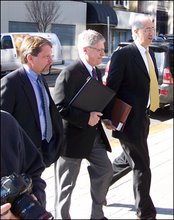
Wade Smith has concluded his testimony and DA Nifong was captured in this undoctored photo responding to his testimony

Wednesday, May 16, 2007

Was Reade Seligmann a Known Innocent on March 16, 2006? – Part II

On the evening of March 16, 2006, Durham Police investigators conducted a series of four photo arrays with false accuser Crystal Mangum. Durham Chief of Police Steve Chalmers described these photo lineups in his report to the mayor and city council as conforming strictly to the procedures outlined by the department’s General Order 4077 which requires the inclusion of five known innocents for each suspect. In total, twenty fillers, men known to be innocent of the false allegations made by Mangum, were included in those photo arrays. According to the report by Chalmers, the known innocents used as fillers in those arrays were each members of the Duke lacrosse team. Included among those fillers was Reade Seligmann, who was eventually charged with crimes that exposed him to the prospect of decades in prison.

If the assertion made by Chalmers – that the photo arrays were composed and conducted properly – is true, the conclusion can be drawn that, as early as March 16, 2006, Reade Seligmann was known to be innocent by the Durham Police Department. Yet, one month later, the two DPD officers investigating the transparently false allegations, Sgt. Mark Gottlieb and Inv. Ben Himan, were the only two witnesses to testify to the Grand Jury that indicted Seligmann. Logically, if Chalmers assertion is true, Gottlieb and Himan would have been the two officers to make the determination on March 16, 2006 that Seligmann and the other 19 fillers were known innocents and therefore valid for inclusion in the lineups. The ramifications of two DPD officers knowingly testifying, under oath, against a known innocent to a Grand Jury at the behest of a corrupt District Attorney are horrifying.

While it may be easier to believe that Chief Chalmers’ claims regarding the inclusion of genuine fillers in the first photo arrays is a blatant falsehood, there remain indications that Seligmann was a known innocent on March 16. If we assume that the Chief is misrepresenting the propriety of the early lineups and accept that in Bizzarro PD Land secondary suspects or “maybe innocents” are used as lineup fillers instead of known innocents, the results of the identification attempt that included Seligmann clearly demonstrated his innocence. If he wasn’t a known innocent prior to his inclusion in the March 16, 2006 photo array, he certainly was a known innocent after the false accuser identified him with only 70% certainty as having been in attendance and stated that she did not recall where she had seen him. Her uncertainty about his presence and her admitted lack of knowledge of where he had been – she ought to have remembered that one place she saw him was in front of her face orally raping her, as she later invented in the subsequent identification procedure on April 4, 2006 - verified his innocence to the officers who would later secure his indictment through their apparently disingenuous testimony before the Grand Jury.

In their December motion to suppress the identification of Seligmann and his co-defendants, the defense attorneys described the early photo arrays that further exonerated Seligmann as follows:

34. Following the accuser’s interview by Inv. Himan and Sgt. Gottlieb, Inv. RD Clayton of the Durham Police Department was asked to conduct a photo identification procedure with the accuser. He was accompanied by a female investigator, Inv. Michelle Soucie. Inv. Clayton was provided with 4 photo arrays; he did not prepare the arrays, nor did he know the status of the persons in the arrays. Discovery at 1667. The first round of discovery provided by the State on May 18, 2006, contained forms signed by the accuser concerning the identification procedure. Discovery at 414, 407, 384 391, and 392. The only detailed narrative of this procedure appears in an undated and unsigned report prepared by Inv. Clayton and provided to the Defendants on June 22, 2006, in the second round of discovery. 2 Discovery at 1667-68.

35. Sgt. Gottlieb had worked with other investigators on the morning of March 16 to compile photographs of the members of the Duke Lacrosse team; these were prepared from a disc provided by the Duke Police Department. Discovery at 1816. Sgt. Gottlieb instructed Inv. Soucie to place these photographs into arrays; only members of the Duke Lacrosse team were placed in the photo arrays that were to be shown to the accuser. The arrays were constructed so that each array contained a player named “Matt,” “Adam,” or “Brett.” Discovery at 1818.

36. Inv. Clayton’s report indicates that he arrived at the accuser’s home at approximately 7:00 pm, less than 72 hours after the claimed assault. He had 4 photo
arrays in 4 folders, each labeled “A,” “B,” “C,” and “D.” Each photo array contained six photographs. The forms provided to the Defendants on May 18, 2006, reflect that the accuser was asked to identify the “person you saw sexually assaulted you.” See, e.g., Discovery at 384. The undated report produced by the State on June 22, 2006, claims that Inv. Clayton instructed the accuser that:

"I informed her that if she did recognize a person in the photo in array [sic] to be as descriptive as possible regarding the details of that person. I then told her to use a scale from 1 –10 if she was able to recognize the person. 1 being the least and 10 being the highest. I gave her an example as 10 being that she positively recognized the person on the photo 100%. Each photo was displayed for 30 seconds. I showed her one photo at a time. After a photo was displayed I did go back to any pervious [sic] displayed photos in the array."

37. Photo Array “A” contained the photographs of Glenn Nick, Kevin Coleman, Matt Zash, John Walsh, Reade Seligmann and Dan Oppedisano. Discovery at 408-413. When first shown Photo Array “A,” according to Inv. Soucie’s notes, the accuser remarked that this was “harder” than she thought it would be. Discovery at 1315. According to the later produced report by Inv. Clayton, “in photo array (A) she stated that the people in the photos looked alike.”

Nonetheless, the accuser “was able to select photo #5 (7 – 10) 70% [Reade Seligmann]. She could not remember where exactly she saw #[5] at the party.” Discovery at 1667.
38. Thus, according to Inv. Clayton’s report, while the accuser was 70% sure that she recognized Reade Seligmann from his photograph, she could not recall where he was at the party.

In a recent story on the impotent report produced by Chalmers and seconded by Durham City Manager Patrick Baker, the News & Observer notes that Baker admits that many of the lacrosse players were cleared prior to the April 4 lineup lottery.

Chalmers and Baker devoted much of their reports to explaining the widely criticized April 4 photo-identification procedure that led to indictments in the case.

The procedure, which did not follow department policy, was not an attempt to identify suspects but to locate witnesses, Baker and Chalmers concluded.

The accuser, Crystal Gail Mangum, had viewed photographs of 36 lacrosse players in March and not identified any assailants. So police, at Nifong's suggestion, showed Mangum photographs of the 46 white members of the team. Mangum had said all the attackers were white.

"This decision to attempt to identify witnesses rather than suspects was driven primarily by the fact that the witness had failed to identify her attackers in six previous suspect identification processes which were governed by" police policy, Baker wrote.

...

"Baker said many players were no longer suspects by the April 4 lineup."

Baker does not identify the many players who were no longer suspects by April 4, 2006 (nor does he reconcile his statement with Chalmers' comical assertion that defense attorneys prevented his department from exonerating the players). It appears, however, that Reade Seligmann was one player who was not only a non-suspect but also a known innocent well before April 4, 2006 and prior to the Grand Jury presentation by Himan and Gottlieb.

Friday, May 11, 2007

DPD Report Expected at 4:00 PM (Updated)

The anticipated report detailing the Durham Police Department's participation in the Nifong/Mangum Hoax will be released today at 4:00PM according to an announcement from the city's Public Affairs Specialist, Amy Blalock.
For Immediate Release: May 11, 2007

Durham City Manager to Release Police Department Report on
Duke Lacrosse Investigation This Afternoon

Durham, N.C. - Durham City Manager Patrick W. Baker will release his report on the Durham Police Department's investigation of the Duke Lacrosse rape allegations today at 4 p.m.

The report will be e-mailed to local media outlets in addition to hard copies being available at the Durham One Call desk in the lobby of City Hall, located at 101 City Hall Plaza, Durham. The report will also be available on the City's website at www.durhamnc.gov.
Apparently, there will be no press conference to announce the findings contained within the report.

Not surprisingly, Durham Chief of Police Steve Chalmers appears to be out of town for the release of the report on his department's participation in the Hoax. Chalmers attended a Police Memorial Service in Wilmington this morning. The 11AM services for fallen Durham Police Officer Officer Charles J. Callemyn, who was killed in a single vehicle accident while responding to a traffic stop on February 17, 2007, were held at Grace Baptist Church.

Look for updates here as additional details on the DPD report become available.

UPDATES:

News & Observer:

The Durham police chief's report about the department's handling of the Duke lacrosse case is expected to be released at 4 p.m. today.

At least one City Council member said the probe shouldn't end there.

"I've come to the conclusion that having a third-party review of our process is actually a good idea," councilman Mike Woodard said.

"I think it removes any doubt about our department looking at its own processes and its own procedures. If we relied solely on the department's report, I think people would consider any findings of that report to be suspect, and there would be concerns about cover up and whitewash."

Baker Memo:
MEMORANDUM

To: Mayor and City Council
From: Patrick W. Baker, City Manager
Date: May 11, 2007
Re: Duke Lacrosse Report

Attached for your review is a copy of a report prepared at my request by Durham Police Chief Steven W. Chalmers in the Duke Lacrosse matter (State v. David Evans, Reade Seligman and Collin Finnerty). I have had the opportunity to review the report and discuss the same with various members of the Police Department.

At the outset, let me acknowledge the City’s concurrence with Attorney General Roy Cooper’s decision to dismiss all of the charges against Evans, Seligman and Finnerty as well as his declaration that these young men are innocent of the charges for which they were indicted. While the criminal proceedings against them have ended, a true and measured analysis and critique of their tortured path to justice is just beginning.

The ultimate question that will be the legacy of this matter is why it took the criminal justice system nearly thirteen months to reach the conclusion that the allegations of rape, sexual assault and kidnapping were unfounded. To answer this question, it is critical to review the specific roles and actions of the individuals involved in this matter, including but not necessarily limited to the complaining witness, individuals at the party, prosecutors, criminal defense attorneys, the Durham Police Department and other investigators and individuals involved in the case. As it relates to the Durham Police Department, I requested Chief Chalmers to focus his review in three very specific areas: 1) define the roles and responsibilities of the Durham Police Department vis-à-vis the Durham District Attorney in this investigation; 2) address concerns related to the April 4, 2006 photo identification process and 3) describe our investigative efforts to uncover exculpatory evidence in this matter.

As it relates to the allegation that the Durham Police Department ceded the entire investigation of this matter to the Durham District Attorney, the report adequately addresses the role the Durham Police Department played in this investigation. The police are a part of the prosecution team and as such it is not unusual for the investigators to work closely and coordinate their investigation with the prosecutor who is ultimately tasked with advancing (or choosing not to advance) a prosecution. In this case, the Durham Police Department worked directly with both the Durham District Attorney and the Office of the Attorney General and coordinated their efforts with each of the relevant prosecutors. In both instances the role of the investigator was to assist the prosecutor in investigating and developing the case. This is a typical relationship between the police and the prosecutor.

I do want to take this opportunity to specifically address the considerable confusion in the media regarding my position on the April 4 photo process. Let me state as clearly as I can that the process by which the former defendants were identified as suspects by the complaining witness was neither conducted nor intended to be conducted in accordance with our recently adopted procedures on eyewitness suspect identification (General Order 4077). Furthermore, I would concur with the Attorney General that “the process by which the accusing witness ultimately identified David Evans, Reade Seligmann and Collin Finnerty as her attackers was of questionable validity.” As stated in the report, it was the primary intent of the investigator at the time the photographs were shown to the witness to have her identify which of the individuals she recalls being at the party rather than to identify her alleged attackers. This decision to attempt to identify witnesses rather than suspects was driven primarily by the fact that the witness had failed to identify her attackers in six previous suspect identification processes which were governed by G.O. 4077. For the stated purpose of obtaining her recollection of the individuals at the party who could be of assistance in the investigation, this process was well suited to achieve that goal. The process however was not well suited for suspect identification primarily due to the fact that it was not conducted with the safeguards provided for in the policy. The identification of her alleged attackers in a process not designed or intended to produce such a result created a significant evidentiary quandary for the prosecutor. Regardless of the intent or expectations of the investigator, the resulting April 4 suspect identifications were procured through a process that would significantly reduce the likelihood that they could have survived the defense motions to suppress their admission into evidence at trial. This issue is magnified substantially given the fact that these photo identifications appear to the strongest incriminating evidence against these young men. It is not lost on the Police Department that regardless of our intentions, the April 4 photo process created the opportunity for the false allegations to be specifically linked to Evans, Seligmann and Finnerty and further played a critical role in the decision by the Durham District Attorney to seek and ultimately obtain indictments of these individuals. Given the ultimate use of the results of showing the witness those pictures on that day, we regret the inadvertent creation of the opportunity to perpetuate false charges against these individuals. Nevertheless, I do not concur with the assertion that the investigators went into the April 4 photo process with the intention, either on their own initiative or at the direction of the District Attorney, to violate G.O. 4077 by inducing the witness to identify her alleged attackers through a less reliable process.
Finally, I need to state that I am deeply troubled by the repeated allegations that the Durham Police Department investigators were not interested in discovering the truth in the matter or as the Raleigh News and Observer put it, “did not pursue basic evidentiary trails to learn what happened at the lacrosse party.” The investigative file is replete with numerous attempts by our investigators to contact witnesses and their attorneys seeking exculpatory statements and evidence. Aside from the initial meeting with the team Captains (including David Evans) there was little if any exchange of the critical exculpatory information and evidence with the Durham Police Department that could have aided in bringing this matter to its rightful conclusion in the early stages of the investigation. One of the examples cited as evidence of our alleged indifference to the truth is the fact that our investigators never subpoenaed photographs apparently in the possession of Kevin Coleman. This assertion ignores the fact that our investigators made repeated requests of numerous attorneys to obtain copies of those photographs to no avail. Furthermore, these photographs along with a video recording and all of the remaining exculpatory evidence the Attorney General found to be so compelling in favor of dismissal were ultimately provided to the special prosecutors by the defense team without the need for a subpoena. In attempting to answer what I believe to be the penultimate question as to why justice took nearly thirteen months to arrive on the scene in this case, I would submit the answer rests primarily in the contrasting relationship between the defense team and the two prosecuting agencies in this matter. The working relationship between the Durham District Attorney’s office and the defense team during the first 10 months of this case was not conducive to an efficient and thorough review of the facts of this case. While I have seen media accounts suggesting that defense counsel made numerous attempts to present the District Attorney with their exculpatory evidence, no such attempt was made by defense counsel to present this information to the Durham Police Department despite numerous requests and opportunities to do so. As such, the opportunities for a free flowing exchange of vital information and evidence that may have established earlier on in the process that the allegations were unfounded were missed. This is particularly important given the dramatic change in the working relationship between the defense team and the Office of the Attorney General once the case was transferred in January. Shortly after the transfer, critical witnesses and exculpatory evidence were voluntarily made available to the prosecution by the defense team for questioning and review which directly led to a swift follow-up investigation and determination to dismiss all remaining charges against the players.

In conclusion, while there are literally hundreds of decisions that went into the prosecution and ultimate dismissal of these charges, the level of cooperation and collaboration between the prosecution and the defense to get to the truth of the matter served as the primary driving force in both the delay and ultimate achievement of justice in this matter. I will await further instructions from Council if you have additional questions or concerns that you would like for the administration to address in this matter.
DPD Report:

Missing Report from Missing Chief Expected Today


City to Release Report About Duke Lacrosse Investigation

Thursday, May 10, 2007

Nifonged in Nicaragua: "I think about her every day"

A touching article by Peter St. Onge in today's Charlotte Observer details the recently forged bond between Mary Ellen Finnerty, the mother of Collin Finnerty, and Maggie Anthony, the mother of Eric Volz. St. Onge writes:
One month before he was declared innocent in the Duke lacrosse rape case, Collin Finnerty came to the breakfast table of his family's Long Island home. "You have to read this," he said to his mother, Mary Ellen.

He pointed her to the family computer, where she found stories about Eric Volz, a 27-year-old American imprisoned for murder in Nicaragua.

She read about the shaky case against Volz, about prosecutors ignoring evidence that cast doubt on his guilt.

She thought instantly about the young man's mother.

The fear. The powerlessness.

She wanted to reach out.

"I knew," she says.

Like Mary Ellen Finnerty, Maggie Anthony is a decorator. The start of 2007 brought promise of exciting projects, but Anthony could focus only on her son's February trial 1,600 miles away. Eric, worried about local anger toward him, urged his mother to stay in Nashville, Tenn.

...

Maggie Anthony went to work. She teamed with her husband and Volz's father to raise defense money and contact media, senators and the State Department. She visited Eric in prison frequently, providing updates on the case and bringing him stacks of supportive e-mail.

On one visit, Eric handed an e-mail back to her. It was from Mary Ellen Finnerty.

`Instantaneous connection'

On April 11, N.C. Attorney General Roy Cooper dismissed rape charges against the three Duke lacrosse defendants. Mary Ellen Finnerty was in North Carolina for the announcement, and her Blackberry soon filled with congratulatory messages.

During a free moment, she scrolled through the well-wishes and stopped, surprised, on one e-mail. Maggie Anthony, unaware of the good news, was writing to thank her for e-mailing Eric.

The two spoke by phone when Finnerty returned to Long Island. They talked about their sons' cases, and about their lives, their fears. Sometimes, there was simply silence.

"There was this instantaneous connection of the heart," says Anthony.

Says Finnerty: "She's a woman of incredible strength."

There is, each says, much that is different in their sons' experiences, but much to share. Each talks about trying to stay strong for their families, and about the importance of showing the world the sons they know. Collin is shy and quiet, says his mother, not the egotistical athlete some painted him to be. Eric, says his mother, is thoughtful and socially conscious, an advocate for women's rights.

Each also talks about tunneling their worries into work for their sons -- but knowing, ultimately, the limits of that work. "It so frightening because you have lost control," says Finnerty. "That's what's so scary."

After that first conversation, Finnerty contacted journalists she met from her son's case to tell them about Eric Volz. "It was frustrating that Eric's case wasn't getting the same press," she says. Perhaps in part from that assistance, the story has gained national attention, led by frequent updates on CNN.

A three-judge panel will hear Volz's appeal at an undetermined date. The U.S. Embassy in Nicaragua is monitoring the case, says consul general Marc Meznar. "We are afraid the judge's decision was influenced by sentiment on the street," he says.

Says Anthony: "We're just waiting."

Says Finnerty: "I think about her every day."

This week, sometime before Mother's Day, the mother from Long Island will call the mother from Tennessee. There will be no updates needed -- Mary Ellen Finnerty checks Eric Volz's Web site regularly -- so the conversation probably won't be long.

It won't have to be.

"You just know that she knows," says Anthony. "She understands."
If time allows, please read the balance of the story here.

Wednesday, May 09, 2007

Two More NC Newspapers Join Call to Prevent Legalized Nifonging

Two additional North Carolina newspapers have joined the call to stop the North Carolina Conference of District Attorneys' attempt to encourage the North Carolina legislature to revise the state's open discovery statute. Earlier this week, the Wilmington Star and Raleigh's News & Observer harshly criticized the effort to legalize nifonging. Today, the Charlotte Observer and Winston-Salem Journal take a more moderate stance in editorials calling for the proposed bills to be defeated in favor of a careful review.

"Do it right," Charlotte Observer:
No need to rush revision of state's `open discovery' law

If anyone wonders why the N.C. General Assembly should be cautious about revising its 2004 "open discovery" law requiring prosecutors to share their files with defense lawyers, here are a few reasons: Darryl Hunt. Alan Gell. And Mike Nifong.

Had a strong open discovery law been in effect and fully implemented years earlier, Darryl Hunt might not have spent more than 18 years in prison for a murder he did not commit. Alan Gell might not have had to endure two trials and time on Death Row for a murder he did not commit.

And had the law not been in effect, Durham District Attorney Mike Nifong could have concealed information from an interview with the accuser by an investigator in the Duke lacrosse case. Notes of that interview indicate she changed her story and wasn't certain a rape occurred. That information, the News & Observer reported, was a factor in the dismissal of rape charges against three Duke players.

These cases ought to remind legislators to be careful about making changes in a law that, unfortunately, North Carolina has shown it needs to protect the innocent from unscrupulous or incompetent prosecutors. The state criminal justice system has sent too many innocent people to prison in cases that sometimes involve prosecutorial misconduct. That's one reason the General Assembly has created a commission on actual innocence to provide a better way to examine credible claims of mistaken convictions.

We believe most N.C. prosecutors are honest, competent and dedicated to catching criminals and taking them to trial. That's as it should be. But we also believe legislators have a responsibility to make sure that prosecutors are not able to keep confidential information that may help establish a defendant's innocence.

District attorneys are concerned that the law requires them to disclose confidential informants as well as personal information about witnesses such as Social Security numbers, reports Anne Blythe of The News and Observer. The DAs fear that having to lay out everything -- and to keep and disclose records of every contact with witnesses -- will undermine their ability to do their jobs. They worry that prosecutors will risk ethics charges if they forget to record even chance meetings with witnesses in a corridor.

Both defense lawyers and prosecutors have valid concerns, but both sides must remember where the public interest lies. It's not important who wins or loses; learning the truth and producing a just result is paramount. The groups should work together with that principle in mind and come up with a solution that achieves two purposes: to provide defendants with information that fairness dictates they should receive; and to address prosecutors' concerns about onerous requirements. There's no reason to make this a rush job. Take the time to do it right.

"Withholding Evidence," Winston-Salem Journal:

It hasn’t been long since Attorney General Roy Cooper ended the yearlong ordeal of three Duke lacrosse players wrongly accused of rape. Yet, the state’s district attorneys want to change the discovery law that helped defense lawyers show that the state had no case against the young men.

The General Assembly should kill the bill and refer prosecutor complaints to a standing study committee, which can independently research whether the discovery law has any serious flaws.

Under a three-year-old North Carolina law, district attorneys are required to share evidence with the defense. The law stems from the wrongful prosecution of a number of North Carolina cases in which prosecutors held back exculpatory evidence — that is, evidence that indicated that the defendants were innocent.

Prosecutors complain that some elements of the law are unfair to their side. But the prosecutors are caught up in the wrong game when they discuss fairness. The goal of a criminal-justice system is not to be fair — it is to provide justice, to convict the people who committed crimes and to punish them appropriately. Implicit in that goal is the exoneration of any defendant who is not guilty.

A prosecutor who discovers evidence that clears an innocent defendant and brings that information to a court’s attention has performed his public duty every bit as well as a prosecutor who gets a conviction of the truly guilty party. Earning a conviction of an innocent person is not a victory for a prosecutor; it is a serious loss for the criminal-justice system.

The prosecutors say that some of the evidence they are forced to hand over to the defense is not exculpatory. But it is not their job to decide what information the defense will not need. Defense attorneys deserve to see all of the evidence so that they can decide how best to build a case for their clients.

The prosecutors are also concerned that the law requires the disclosure of confidential informants and of information that witnesses do not want released.

Both of those issues were rigorously debated in the General Assembly when the law passed several years ago. Legislators decided, at that time, in the wake of several prosecutorial scandals, that the defense needed that information. It is important to remember that, while North Carolina has a long tradition of fair and distinguished service by prosecutors, defense attorneys and judges, it also has had a number of deviations from that record of honor.

Prosecutors lost their argument three years ago. Without presentation of an overwhelming body of evidence that shows this law is not working, their appeal of the legislature’s earlier decision should be denied.

Not surprisingly, Durham's Herald-Sun remains silent on the issue after having enthusiastically encouraged Defendant Mike Nifong's campaign to defy the state's open discovery statute.

Wednesday, May 02, 2007

Tuesday, May 01, 2007

When A Lineup is Not A Lineup and A Suspect is Not A Suspect

Apparently determined to continue defending the universally condemned identification procedure that allowed three innocent men to be railroaded by Durham County’s rogue district attorney, Durham City Manager Patrick Baker has creatively expanded his Nifong-esque non-lineup lineup argument. Baker's latest revisionist spin now claims that the corrupt identification procedure directed by Mike Nifong and conducted by Baker’s police department was appropriate because it included imaginary non-suspects as well as suspects.

Today’s Herald Sun reports:
"The lacrosse photo array is still under scrutiny.

A police general order says photo lineups should include pictures of people other than possible suspects. It also suggests they should be administered by neutral parties rather than officers who might have a vested interest in the outcome.

A photo procedure used in the lacrosse case met neither of those guidelines.

However, City Manager Patrick Baker said Sunday that it didn't need to, since it wasn't intended to be a lineup in the usual sense.

"The Police Department believed then -- and still believes -- the general order was not applicable," Baker added.

The reason, he said, is that the photo procedure was intended to identify witnesses as well as -- or instead of -- suspects in the case.

"It would not be a lineup if you simply asked the accuser if she recognized anyone from the [lacrosse] party," according to Baker. "You have suspects and nonsuspects."
Despite Baker’s creative assertion, the non-testimonial identification order by which the photographs were obtained specifically for use in "photographic lineups to identify suspects" states clearly to each of the forty-six subjects of the photo array that there were grounds "to suspect that you committed" the imaginary assault.

To each of the forty-six suspects, the non-testimonial order signed by Judge Ronald Stephens states:
The undersigned finds that there is probable cause to believe that the offense named above, which is punishable as a felony or Class A1 or Class 1 misdemeanor, has been committed.

There are reasonable grounds to suspect that you committed the offense and that the results of the procedures ordered here will be of material aid in determining whether you committed the offense. The grounds to believe that an offense has been committed, to suspect that you committed it, and to believe that this Order will be of material aid in confirming or negating the suspicion, are stated in the attached application and affidavit. Your presence is required for the purpose of permitting non-testimonial identification procedures in order to aid in the investigation of the offense named above.

The methods to be used and the time required to conduct the non-testimonial procedures are as follows:

Procedures for non-testimonial identification

Photographic documentation and identification; DNA
In his affidavit requesting the NIO, the Durham Police Department's Inv. Benjamin Himan swears for each of the forty-six suspects:
“I have reasonable grounds to suspect that the person named or described on the reverse committed the offense.”

“The photographs used for mug shots will give the availability of the suspects' current hair styles, complexion and body mass for photographic lineups to identify suspects.”


Contradicting Baker's erroneous perspective, North Carolina law offers no provision for non-testimonial identification orders of non-suspects. The statute reads:
§ 15A-271. Authority to issue order.
A nontestimonial identification order authorized by this Article may be issued by any judge upon request of a prosecutor. As used in this Article, "nontestimonial
identification" means identification by fingerprints, palm prints, footprints,
measurements, blood specimens, urine specimens, saliva samples, hair samples, or other reasonable physical examination, handwriting exemplars, voice samples, photographs, and lineups or similar identification procedures requiring the presence of a suspect. (1973, c. 1286, s. 1; 1975, c. 166, s. 27.)

§ 15A-273. Basis for order.
An order may issue only on an affidavit or affidavits sworn to before the judge and
establishing the following grounds for the order:
(1) That there is probable cause to believe that a felony offense, or a Class
A1 or Class 1 misdemeanor offense has been committed;
(2) That there are reasonable grounds to suspect that the person named or
described in the affidavit committed the offense; and
(3) That the results of specific nontestimonial identification procedures will
be of material aid in determining whether the person named in the
affidavit committed the offense. (1973, c. 1286, s. 1; 1997-80, s. 14.)
Clearly, each of the photographs was obtained for the sole purpose, as described by DPD Inv. Himan and ordered by Judge Stephens, of inclusion in photographic lineups. Further, the photographs were secured based on the sworn assertion of DPD Inv. Himan that each of the forty-six subjects were suspected of committing the crime that never occurred.

Baker's contention that the non-lineup lineup included both non-suspects and suspects appears to contradict the assertions made by Inv. Himan that each of the forty-six subjects of the NIO were suspects. Certainly, it defies logic that any one of the forty-six players could have simultaneously been both a suspect and a non-suspect. Had anyone of them not been a suspect, as Baker suggests to support his fragile claim that the lineups were acceptable, Inv. Himan's sworn statement must be false. By clinging to Defendant Nifong's illogical claims, Baker creates an argument that implodes upon itself. To support Nifong's lineup and absolve his police department's complicity, Baker has created an argument that requires him to admit that Inv. Himan deceived Judge Stephens into believing that each of the forty-six men were genuine suspects.

Giving Baker's argument the widest benefit of the doubt and assuming that there were indeed non-suspects included illegally in the non-testimonial identification order, does not lend much support to the notion that the non-lineup lineups were acceptable procedure. If there were non-suspects included in the NIO, a very strong argument could be made that the three wrongfully indicted players would have been among them. In fact, the December 14 motion to suppress the identifications did exactly that while eviscerating the merits of the non-lineup lineup lottery.

To summarize the arguments made in the motion:
  • Reade Seligmann was identified by the false accuser prior to the NIO with only a 70% certainty of having been in attendance and with no recollection of what he had been doing.
  • Reade Seligmann did not match the descriptions given by Nifong's co-hoaxer.
  • David Evans photograph had been viewed twice prior to the NIO by the psuedo-victim with no recognition upon either viewing.
  • Collin Finnerty did not match the descriptions given by the false accuser.
  • Collin Finnerty was not included as a suspect in either of the two photo arrays that preceded the NIO.
Without assuming that City Manager Baker has no intention of offering an honest accounting of the Durham Police Departments complicity in the Nifong/Mangum Hoax, it is difficult to understand why he continues to put himself through such extreme contortions of logic and law to defend a transparently corrupt identification procedure, the deficiencies of which have been exposed by the devastating review from the Attorney General's special prosecutors, the objective examination of independent experts, and an excoriating forty-six page defense motion. If by no other measure than the simple fact that the procedures employed by his police department led to the wrongful indictments of three factually innocent men while allowing an obviously fraudulent accuser and a politically motivated rogue prosecutor to perpetuate a Hoax of monumental proportions that ripped his community asunder and left little confidence in the integrity of the police department he oversees, Baker must know that the lineup he defends had no investigative merit, no integrity, and no possibility of a result other than the indictment, arrest, and prosecution of innocent men.

Monday, April 30, 2007

Sleeping with Snakes

My son is the oldest, and he was the first to leave the nest ... off to a large university to try his wings on his own. He was ready. I was not. I fussed over details, fretted over my loss of control. Would he get enough sleep? Would he eat? Would he study? My husband enrolled him in a private dorm option, mainly, in retrospect, for my mental health. So off he went. He looked so young to me, and yet, all the early reports from him were glowing and positive.

On Parents Weekend, he met us in the lobby of his dorm. He looked uneasy. As we approached the door to his room, he faced me full on and warned, "Mom, promise me you won't say anything! Promise!" The door swung open.

He was living with a boa constrictor.

Oh, yes. This private dorm that I insisted on ... allowed his roommate to keep a pet. My son, the focus of eighteen years of close maternal oversight, was now sleeping in a room with his head inches away from a very big and powerful snake.

You cannot make this stuff up.

For weeks after our visit, ... out to lunch with friends, cooking dinner, drifting off to sleep ... I'd be jolted by the memory of The Snake in the Dorm Room. At one point, I did a little research, and I called my son and asked him the dimensions of the fish tank the creature was living in. He hung up.

So, I've been thinking about the Moms again. No, not Rae, Mary Ellen, and Kathy... though I still think of them often. No, I've been thinking about the Moms who are about to send their children off to school for the first time this fall... to Duke, to Durham. My Snake in the Dorm Room scenario is small potatoes compared to what they must be feeling if they've followed this Nifong-Mangum Hoax. The Herald Sun has this quote today from a George Washington University law professor:
"It's all very, very damning [to Nifong]," (Professor) Banzhaf said of the report. "He should be forced to step down, and there should be civil action. I think he presents a clear and present danger to students at Duke. He has clearly demonstrated a desire to violate their constitutional rights. I'd be a little frightened if I were a parent looking at my kid's acceptance letter from Duke."
So would I, Mr. Banzhof.

In Durham, although violent crime was up a stunning 32% in 2006, enormous resources were used to engage in a false prosecution of three Duke students. In Durham, gang violence is escalating out of control, but Durham police have been told to target Duke student partygoers. To add to the local atmosphere, Duke students can breathe in the pollution from the frequent waste dump fires (two in the last two years), drink the lead infused Durham tap water, and dodge the life threatening rock-droppers on the freeway.

Yes, all this, Duke parents, can be yours for around $45,000 a year! Why it's like sending your child on a four-year action adventure vacation! Consider the thrilling uncertainties! My child, can you achieve your Duke degree and still survive the toxic situation in the town outside the gate? Can you navigate the streets without a Gottlieb-grab? Can you complete four years without our family being nifonged into financial ruin? Can you pass classes taught by professors who despise you? Perfect for those seeking the "high" of extreme sports, matriculating at Duke also offers the survivors the thrill of a real life video game and the possibility of a prestigious degree to boot!

For that $45,000 price tag, just what "customer service" is the leadership of Duke University promising all the Moms and Dads who write the checks? Well, for insight, here is Duke's latest statement from John Burness:
"Duke senior vice president John F. Burness issued the following statement after the N.C. Attorney General's Office on Friday released its Summary of Conclusions in the Duke lacrosse case

Friday, April 27, 2007
Durham, NC -- “Attorney General Cooper’s Summary of Conclusions that was released today documents the absence of any credible evidence that would justify any conclusion in this case other than the one Mr. Cooper announced a few weeks ago -- that David Evans, Collin Finnerty and Reade Seligmann are innocent of all charges brought against them last spring by District Attorney Nifong. We welcome this report as we welcomed the Attorney General’s announcement on April 11.

“We now await the N.C. State Bar’s review of the charges against Mr. Nifong for his conduct in this case.”
Got that, Duke freshmen parents? The current leadership of Duke University's response to Cooper's astounding findings is to meekly "now await" what might happen to the Snake in the Prosecutor's Office. I'm amused by that phrase "now await." Gee, last year, 88 Duke faculty members were lauding activists, who were publicly demanding castration, for "not waiting." Why the hesitancy and hand-wringing now? How about a little consistency? How about actually stepping out to make the very environment your students are paying $45,000 for you to provide, a reasonably safe place for them to reside? How about you, Mr. Brodhead, or you, Mr. Burness, or some member of the Law faculty, how about SOMEONE finally publicly recognizing the enormous wrong done to the Finnerty, Seligmann and Evans' families this past year? Now that it's safe to come out from hiding, how about the leadership of Duke University filing a 7A-66 affidavit to remove the viperous Mike Nifong, as the courageous Beth Brewer has done at great personal risk?

How about putting Judge "Not acting is acting" Hudson under some pressure from the largest employer in the area? How about publicly making it clear that Duke will not abide a corrupt prosecutor who targets its students without a scintilla of evidence? The state's attorney has laid out the scenario for you, Mr. Brodhead. Some presume you summarily fired Mike Pressler for "appearances" sake. Then, what explains your boundless tolerance of rogue prosecutor Mike Nifong ... faculty appeasement? You know, Dick... you don't have to wait for the Bar hearing. North Carolina's Attorney General has told you whatever Nifong did "was bad enough."

I also think about another group of ravaged Moms (and Dads) I read about recently... the Durham chapter of Parents of Murdered Children. I think of how it must feel to those families, who love their children no less than you or I, to have observed last year's legal farce play out. To see through their eyes the manpower and money squandered by Mike Nifong's self-interested pursuit of false rape charges against three Duke students! I invite any of these parents to contact LieStoppers and tell us if their children's murders were given that same zeal, that same expenditure of effort and intensity Nifong lavished on the Hoax. Not that any of them would sanction, nor do we, Nifong's illegal line-up lotteries, witness intimidations, invented or non-existent notes, and numerous lies both in and out of the courtroom ... but it does speak to the exceptional effort that Inspecteur D.A. put into this shameful debacle.

But what about these murdered children of Durham? Could it be that their cases fell into no fortuitous political "meta narrative" for Nifong to exploit? Could it be that these murdered children, these anguished families, these little known cases received minimal attention or respect? Could it be that these families are not "privileged" enough to be worthy of the excessive devotion Nifong gave to pushing a case HE KNEW HAD NO MERIT before he sought indictments? Though some of these cases involve Durham's gang violence, each victim is still someone's much loved child. Perhaps the tragedies of these Durham families, personally useless to Defendant Nifong, are simply deemed expendable.

There is a Snake in the Prosecutor's Office in Durham. His name is Michael B. Nifong. Nifong, the 27 yr. assistant DA, "shed his skin" as soon as he was given the reins of power. Like all snakes, Nifong depended on his sense of smell, and he immediately smelled the race-pandering opportunity in the Hoax. He cannot shed his scales at this late date and ask a nation to forget or these families to forgive. City Manager Baker could have been Saint Patrick and acted to rid Durham of this poisonous snake. Instead, Baker currently seems to have chosen to play Cleopatra and clutch the venomous asp to his city's bosom. This is unacceptable to decent people everywhere. We need, Mr. Brodhead, to "await" NOTHING. We demand some leadership.

Indeed, the Durham power structure is stalling, hoping to keep Nifong coiled at their collective feet, ready to rise to their music and strike at their will. We understand now, that's how the game works. In the days ahead, we will see who is most invested in retaining Durham's Snake in the Prosecutor's Office. We must watch and listen carefully. The official cover-up is about to begin. The leadership of Durham and Duke must again be judged by what they DO and do Not do in the weeks ahead. It will be a road map pointing to who is guilty... and who is fork-tongued, and who is exceedingly, institutionally gutless.

Joan Foster