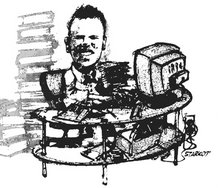
What’s that you say, Mr. Robinson?
.
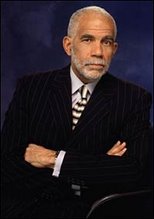
Have logic and justice left and gone away? This question should be on everyone’s mind after reading Duke Law School Professor Robinson Everett’s defense of DA Nifong in the
Herald-Sun yesterday..
Professor Everett endorsed DA Nifong in the primary and general elections. Unlike Citizen’s Committee Co-Chair Kim Brummel, who demanded Nifong apologize for his unethical conduct, Professor Everett apparently sees nothing wrong with DA Nifong’s decision to hide evidence in the Hoax. He apparently believes that Wendy Murphy understands the issues raised by Nifong’s conduct better than his fellow Duke law professor James Coleman. Everett argues that it is unclear whether “Nifong had any duty to provide the defense with evidence about the presence on the accuser’s body of semen from other persons who were not lacrosse players.” Everett cites North Carolina’s rape shield law, rule or evidence 412 and suggests that it allows a District Attorney to hide evidence he doesn’t think will ultimately be admitted at trial.
.
Everett states:
“Rule 412 contains four narrow exceptions which might allow receipt of evidence that alleged victim had sexual relations with persons other than the lacrosse players; but, after examining the rule, I doubt that those exceptions would apply in this case. Therefore, Judge Smith, who will try the case, may not allow the jury to hear this evidence – although the evidence clearly should be admissible that the tests revealed no semen from the lacrosse players on the body of the accused…I wonder whether the district attorney violated any constitutional or statutory requirement if he had the laboratory delete from its “reports of test result” those that would be inadmissible at trial but which he fears the defense might use to attack the accuser’s character.”
Rule 412 states the following:
(b) Notwithstanding any other provision of law, the sexual behavior of the complainant is irrelevant to any issue in the prosecution unless such behavior:
(1) Was between the complainant and the defendant; or
(2) Is evidence of specific instances of sexual behavior offered for the purpose of showing that the act or acts charged were not committed by the defendant; or
(3) Is evidence of a pattern of sexual behavior so distinctive and so closely resembling the defendant's version of the alleged encounter with the complainant as to tend to prove that such complainant consented to the act or acts charged or behaved in such a manner as to lead the defendant reasonably to believe that the complainant consented; or
(4) Is evidence of sexual behavior offered as the basis of expert psychological or psychiatric opinion that the complainant fantasized or invented the act or acts charged.
Let’s set aside (4) and its potential relevance for the time being. How in the present case is it even remotely possible to argue that (2) does not apply? How can anyone, let alone a distinguished professor of law, argue that multiple DNA samples found on the accuser in this case are not “evidence of specific instances of sexual behavior offered for the purpose of showing that the act or acts charged were not committed by the defendants”? Isn’t that exactly why the other DNA from at least four unidentified males is relevant? Nifong didn’t even try to argue the Robinson Everett/Wendy Murphy theory to the court, to the media, or to the NC Bar Grievance Committee. Does Professor Everett really believe the lawyer he publicly endorsed for district attorney is so incompetent that he didn’t raise an obvious argument in his own behalf and instead chose first to deny knowledge and then to make up a story about protecting the players’ privacy? Even with his career on the line, does Everett actually believe that Nifong just missed that argument or forgot his true motivations?
.
Perhaps DA Nifong’s reluctance to use Everett’s argument was due to the fact that he said repeatedly on national television and to local Durham media that he believed the accuser’s story because of the medical report from Duke Hospital, which he asserted showed vaginal trauma, and which the police described in multiple search warrants by stating, “Medical records and interviews that were obtained by a subpoena revealed the victim had signs, symptoms, and injuries consistent with being raped and sexually assaulted vaginally and anally.”
.
Setting aside the fact that the medical records said no such thing and only noted diffuse edema of the vaginal walls, is Professor Everett seriously arguing that DNA found in the vaginal vault, in the rectum, and on the accuser’s underwear that doesn’t match any of the lacrosse players should be excluded from evidence because it isn’t relevant? Is he seriously arguing that DA Nifong was justified in withholding this evidence, even as his office leaked to the press the “non-exclusion” of Dave Evans from a DNA pool created from multiple plastic fingernails found in the trashcan in Evans’ bathroom? How exactly could a defendant respond to such claims in Mr. Robinson’s evidentiary neighborhood? The prosecution would assert the “injuries” were caused by the defendant, because if the defendant didn’t cause them, who did? Then the defendant would say what? Does Robinson Everett really believe a court would prevent a defendant from suggesting that the multiple donors of the recovered DNA samples may have caused the “injuries”? As controversial as rape shield laws are, does Everett really believe they operate that irrationally?
.
Furthermore, the additional DNA samples in this case are highly relevant for two other important reasons. First, the accuser claimed that at least one of the accused ejaculated. The apparent justification for why no DNA was found is a magic towel that managed to wipe away all the accused’s DNA, but left the DNA of other men. How can the defense be precluded from offering the other DNA as evidence against the magic towel theory? Second, the accuser claims that she didn’t have sexual relations with anyone prior to the party and only had sex with her boyfriend a week earlier. This claim is directly relevant to the significance attached to any medical evidence of “trauma” in her vaginal area. How can DNA evidence to the contrary possibly be considered irrelevant to the question?
.
Most importantly, it must be noted that Everett supports his argument by miscontsruing the rape shield law in stating, "Rule 412 contains four narrow exceptions which might allow receipt of evidence." In fact, Rule 412 contains four narrow exceptions which might allow presentation of evidence at trial and does not speak to receipt of evidence except to specifically state the opposite of what Everett falsely claims: "...all evidence relating thereto shall be open to inspection only by the parties, the complainant, their attorneys and the court and its agents."
.
Further, the statute outlines the procedure by which the evidence in question must be presented to the court so that a ruling on admissibility is made by a judge and not the prosecutor.
(d) Notwithstanding any other provision of law, unless and until the court determines that evidence of sexual behavior is relevant under subdivision (b), no reference to this behavior may be made in the presence of the jury and no evidence of this behavior may be introduced at any time during the trial of:
(1) A charge of rape or a lesser included offense of rape;
(2) A charge of a sex offense or a lesser included offense of a sex offense; or
(3) An offense being tried jointly with a charge of rape or a sex offense, or with a lesser included offense of rape or a sex offense.
Before any questions pertaining to such evidence are asked of any witness, the proponent of such evidence shall first apply to the court for a determination of the relevance of the sexual behavior to which it relates. The proponent of such evidence may make application either prior to trial pursuant to G.S. 15A-952, or during the trial at the time when the proponent desires to introduce such evidence. When application is made, the court shall conduct an in camera hearing, which shall be transcribed, to consider the proponent's offer of proof and the argument of counsel, including any counsel for the complainant, to determine the extent to which such behavior is relevant. In the hearing,the proponent of the evidence shall establish the basis of admissibility of such evidence. Notwithstanding subdivision (b) of Rule 104, if the relevancy of the evidence which the proponent seeks to offer in the trial depends upon the fulfillment of a condition of fact, the court, at the in camera hearing or at a subsequent in camera hearing scheduled for that purpose, shall accept evidence on the issue of whether that condition of fact is fulfilled and shall determine that issue. If the court finds that the evidence is relevant, it shall enter an order stating that the evidence may be admitted and the nature of the questions which will be permitted.
Nowhere in Rule 412 is there a provision for allowing the prosecutor to usurp the role of the court in determining what evidence is admissible and what evidence must be provided to the defendants. It is difficult to understand how the court could rule on the admissibility of evidence hidden from it by a prosecutor. The Supreme Court of Wisconsin appears to agree with our assessment that Everett misconstrues the letter of the statute:
"The State primarily argues that the undisclosed information is not material because it would not have been admissible, as it does not meet the Pulizzano exception to the rape shield law...
.
"We also disagree with the State's argument that this evidence is not material because we determine that the State's nondisclosure of this evidence sufficiently undermines our confidence in the outcome of Harris's criminal proceeding.
While the State argues at length that the undisclosed evidence is not material because it does not meet the Pulizzano test, we find this argument to be unpersuasive because the State never afforded Harris the opportunity to bring a Pulizzano motion in the first place. We need not determine whether the five factor Pulizzano test would have been met in this case because even if the test would have been met, the circuit court would still have been obligated to balance Harris's right to present the evidence against the interest of the State in excluding it." State v. Harris
Robinson Everett ignores all these well-known facts and obvious questions and suggests that Nifong was justified in hiding evidence “that would be inadmissible at trial but which he fears the defense might use to attack the accuser’s character.” One wonders whether Everett is following any of the facts in this case or is instead just writing letters to the News & Observer and Herald-Sun because he assumes his intellect is so superior that the community would benefit from his baseless musings. We can only hope that justice’s version of “Joltin’ Joe” and the rest of the defense team can ultimately convince the special prosecutors to dismiss the charges in this Hoax. Until that day comes, Hoax enablers like Robinson Everett can only cause the rest of us to look to the sky and remember that “heaven holds a place for those who pray.”