Showing posts with label NC General Assembly. Show all posts

Wednesday, August 08, 2007

What happened to legislation requiring grand jury transcripts?

The North Carolina General Assembly adjourned on August 2, 2007 without passing much needed reform of the current grand jury system, insuring NC will remain in the legal dark ages. By not requiring a record of grand jury proceedings, prosecutors are free to follow disbarred DA Mike Nifong's bad example and deny defendants a probable cause hearing where a lack of evidence and fraudulent affidavits, as in the Duke Hoax case, could be revealed early in the process. Instead, cynical prosecutors may continue pretending that an easily manipulated grand jury has the tools and ability to conduct a true hearing of available evidence, both inculpatory & exculpatory.

In the Duke Lacrosse Case the grand jury only heard from Durham PD Officers Gottlieb & Himan when it indicted the now declared innocent lacrosse players. Were the jurors informed that former DA Nifong, Gottlieb, and Himan learned on April 10, a week before seeking indictments, that DNASI had found DNA from multiple unknown men, none of whom were at the party? Were they told that no lacrosse player's DNA was ever found in the false accuser's swabs? We doubt it, but we will never know what that grand jury was told as no transcripts are allowed. We do, however, have the words of one grand juror who said anonymousy:

"Knowing what I know now and all that's been broadcast on the news and in media, I think I would have definitely … made a different decision," he said to ABC News.

In the immediate fallout of this case, there was talk of grand jury reform and hope for change. In May, LieStoppers reported on several proposed changes to legislation.

“Senate Bill 1131 proposes to have all Grand Jury proceedings recorded and transcribed while also allowing Grand Jurors to report prosecutorial misconduct to federal law enforcement authorities after consulting with and gaining the permission of the presiding judge.All proceedings of the grand jury shall be recorded and transcribed. Records and transcriptions of grand jury proceedings are not public records under Chapter 132 of the General Statutes.”“[W]e strongly support the [proposal] to record Grand Jury proceedings – had this been the case for the Durham Hoax, there would be a record of the misrepresentations presented by DPD officers Himan and Gottlieb on behalf of Defendant Nifong…”

What happened to SB1131?

In late May, a senate subcommittee recommended a substitution for SB1131. The substitute….“AN ACT allowing a district court judge to perform marriage ceremonies” and in July Governor Easley signed this change to N.C.G.S. 51-1 into law.

Okay. That’s great... for a man and woman wishing to be married, but what about grand jury transcripts which could prevent future Nifonging of innocents?

On a more positive note, SB1130, titled “Open Discovery/AOC Changes,” passed and was signed into law. It is described as “AN ACT clarifying that defendants must have access to the complete files of all law enforcement, to make changes to the State Budget Act as it applies to the Judicial Branch, to add a new duty to the Director's powers and duties, to modify or repeal certain statutes related to drug treatment courts, to establish a pilot program in several counties for electronic court filings, to make clarifying changes for continuing training for magistrates; and to prohibit magistrates from the private practice of law.”

Of course, nowhere does it state that a police officer must keep notes or record interviews. So Sgt. Mark “No notes” Gottlieb can keep his Dry Erase Board and hope that Ben “With what?” Himan may occasionally photograph it for discovery. Miraculously recovered memories are still safe, which comes in handy when filling in large holes in cases.

LieStoppers is deeply disappointed that the North Carolina General Assembly, despite being nationally humiliated for having an easily manipulated grand jury system which wrongly indicted three totally innocent men for a crime which never happened, has chosen to do nothing. NC remains a state where another Nifong can easily “indict a ham sandwich,” as it has not addressed the system failures which allowed the wrongful indictments in the Duke Lacrosse Hoax.

Sunday, May 20, 2007

Just Say "NO" to Nifonging

On Tuesday, the Civil Judiciary Committee (Judiciary I) of the North Carolina Senate will meet to consider three Bills that are relevant to the protection of all citizens from the injustice perpetrated in the Durham Hoax. We strongly oppose one of the proposed laws, an effort to undo the State's open discovery law; fully support the second, an effort to broaden the same discovery statute; and, with one reservation, support the third, an effort to provide recording and transcription of Grand Jury proceedings that includes a procedure for the reporting of prosecutorial misconduct to federal law enforcement officials. Like minded and equally concerned citizens are encouraged to contact the members of the Judiciary I Committee prior to Tuesday's meeting.

The bills to be addressed on Tuesday are:
  1. Senate Bill 1009 - Discovery/DA Work Product - Sponsored by Sen. Tony Rand
  2. Senate Bill 1130 - Broaden Open Discovery - Sponsored by Sen. Daniel Clodfelter
  3. Senate Bill 1131 - Grand Jury Reform/Prosecutorial Misconduct - Sponsored by Sen. Daniel Clodfelter
We strongly oppose Senate Bill 1009 as an attempt to rollback the open discovery laws that allowed for the exposure of the Durham Hoax. Discussions of the Legalize Nifonging Bill and the deceptive arguments employed by the State’s elected District Attorneys to promote it can be found here: NC DA's Push For Legalized Nifonging and Two More NC Newspapers Join Call to Prevent Legalized Nifonging.

Senate Bill 1130 offers one modification to the open discovery statute. The bill proposes to add the following statement to the statute:
The term "prosecutorial agency" includes any public or private entity that obtains information on behalf of a law enforcement agency or prosecutor in connection with the prosecution of the defendant.
The clarification would include labs such as Dr. Brian Meehan’s DNA Security, Inc. as a "prosecutorial agency" subject to open discovery. As such, the proposal broadens the open discovery law. We welcome Bill as an effort to broaden the State's progressive open discovery law.

Senate Bill 1131 proposes to have all Grand Jury proceedings recorded and transcribed while also allowing Grand Jurors to report prosecutorial misconduct to federal law enforcement authorities after consulting with and gaining the permission of the presiding judge.
All proceedings of the grand jury shall be recorded and transcribed. Records and transcriptions of grand jury proceedings are not public records under Chapter 132 of the General Statutes.

[Grand Jurors] May confer with, and report to, the presiding or convening judge concerning possible prosecutorial misconduct or any other matter that could adversely affect the independence, fairness, and impartiality of the grand jury.

Notwithstanding G.S. 15A‑623 or any other provision of law, the grand jury may, after consultation with the presiding or convening judge and only with that judge's permission, report to federal law enforcement authorities on prosecutorial misconduct and any other matter that could adversely affect the independence, fairness, and impartiality of the grand jury.
While we strongly support the proposals to record Grand Jury proceedings – had this been the case for the Durham Hoax, there would be a record of the misrepresentations presented by DPD officers Himan and Gottlieb on behalf of Defendant Nifong – and to allow the Grand Jury to report prosecutorial misconduct to federal authorities, we are reluctant to endorse the requirement that permission from a local judge be granted first. Given Superior Court Judge Orlando Hudson’s defiance of State Law on behalf of District Attorney Nifong in the matter of the petition to remove him for office, it is difficult to trust that other Judges would not follow Hudson’s lead and favor a familiar ally above the law and over the lawful request of concerned citizens. Even if the bill were modified to require the presiding Judge to act on the request for permission to report prosecutorial misconduct, Hudson’s refusal to follow the statute requiring him to act on the 7A-66 petition offers no assurance that a resident Judge would act against a favored prosecutor.

Contact information for the nineteen members of the Senate Judiciary I Committee follows below. Please take a few moments to express your opinions on these Bills directly to the committee members by clicking the email links provided.

North Carolina Senate Judiciary I Committee Members:

ChairmanSen. Martin L. Nesbitt, Jr.
Vice ChairmanSen. Philip E. Berger
Vice ChairmanSen. Daniel G. Clodfelter
Vice ChairmanSen. R. C. Soles, Jr.
MembersSen. Charles W. Albertson, Sen. Julia Boseman, Sen. Andrew C. Brock, Sen. Harry Brown, Sen. Peter Samuel (Pete) Brunstetter, Sen. Janet Cowell, Sen. Malcolm Graham, Sen. David W. Hoyle, Sen. Clark Jenkins, Sen. Eleanor Kinnaird, Sen. Vernon Malone, Sen. Floyd B. McKissick, Jr., Sen. Tony Rand, Sen. Richard Stevens, Sen. Jerry W. Tillman

Click here to copy one email to all 19 committee members.

Wednesday, May 09, 2007

Two More NC Newspapers Join Call to Prevent Legalized Nifonging

Two additional North Carolina newspapers have joined the call to stop the North Carolina Conference of District Attorneys' attempt to encourage the North Carolina legislature to revise the state's open discovery statute. Earlier this week, the Wilmington Star and Raleigh's News & Observer harshly criticized the effort to legalize nifonging. Today, the Charlotte Observer and Winston-Salem Journal take a more moderate stance in editorials calling for the proposed bills to be defeated in favor of a careful review.

"Do it right," Charlotte Observer:
No need to rush revision of state's `open discovery' law

If anyone wonders why the N.C. General Assembly should be cautious about revising its 2004 "open discovery" law requiring prosecutors to share their files with defense lawyers, here are a few reasons: Darryl Hunt. Alan Gell. And Mike Nifong.

Had a strong open discovery law been in effect and fully implemented years earlier, Darryl Hunt might not have spent more than 18 years in prison for a murder he did not commit. Alan Gell might not have had to endure two trials and time on Death Row for a murder he did not commit.

And had the law not been in effect, Durham District Attorney Mike Nifong could have concealed information from an interview with the accuser by an investigator in the Duke lacrosse case. Notes of that interview indicate she changed her story and wasn't certain a rape occurred. That information, the News & Observer reported, was a factor in the dismissal of rape charges against three Duke players.

These cases ought to remind legislators to be careful about making changes in a law that, unfortunately, North Carolina has shown it needs to protect the innocent from unscrupulous or incompetent prosecutors. The state criminal justice system has sent too many innocent people to prison in cases that sometimes involve prosecutorial misconduct. That's one reason the General Assembly has created a commission on actual innocence to provide a better way to examine credible claims of mistaken convictions.

We believe most N.C. prosecutors are honest, competent and dedicated to catching criminals and taking them to trial. That's as it should be. But we also believe legislators have a responsibility to make sure that prosecutors are not able to keep confidential information that may help establish a defendant's innocence.

District attorneys are concerned that the law requires them to disclose confidential informants as well as personal information about witnesses such as Social Security numbers, reports Anne Blythe of The News and Observer. The DAs fear that having to lay out everything -- and to keep and disclose records of every contact with witnesses -- will undermine their ability to do their jobs. They worry that prosecutors will risk ethics charges if they forget to record even chance meetings with witnesses in a corridor.

Both defense lawyers and prosecutors have valid concerns, but both sides must remember where the public interest lies. It's not important who wins or loses; learning the truth and producing a just result is paramount. The groups should work together with that principle in mind and come up with a solution that achieves two purposes: to provide defendants with information that fairness dictates they should receive; and to address prosecutors' concerns about onerous requirements. There's no reason to make this a rush job. Take the time to do it right.

"Withholding Evidence," Winston-Salem Journal:

It hasn’t been long since Attorney General Roy Cooper ended the yearlong ordeal of three Duke lacrosse players wrongly accused of rape. Yet, the state’s district attorneys want to change the discovery law that helped defense lawyers show that the state had no case against the young men.

The General Assembly should kill the bill and refer prosecutor complaints to a standing study committee, which can independently research whether the discovery law has any serious flaws.

Under a three-year-old North Carolina law, district attorneys are required to share evidence with the defense. The law stems from the wrongful prosecution of a number of North Carolina cases in which prosecutors held back exculpatory evidence — that is, evidence that indicated that the defendants were innocent.

Prosecutors complain that some elements of the law are unfair to their side. But the prosecutors are caught up in the wrong game when they discuss fairness. The goal of a criminal-justice system is not to be fair — it is to provide justice, to convict the people who committed crimes and to punish them appropriately. Implicit in that goal is the exoneration of any defendant who is not guilty.

A prosecutor who discovers evidence that clears an innocent defendant and brings that information to a court’s attention has performed his public duty every bit as well as a prosecutor who gets a conviction of the truly guilty party. Earning a conviction of an innocent person is not a victory for a prosecutor; it is a serious loss for the criminal-justice system.

The prosecutors say that some of the evidence they are forced to hand over to the defense is not exculpatory. But it is not their job to decide what information the defense will not need. Defense attorneys deserve to see all of the evidence so that they can decide how best to build a case for their clients.

The prosecutors are also concerned that the law requires the disclosure of confidential informants and of information that witnesses do not want released.

Both of those issues were rigorously debated in the General Assembly when the law passed several years ago. Legislators decided, at that time, in the wake of several prosecutorial scandals, that the defense needed that information. It is important to remember that, while North Carolina has a long tradition of fair and distinguished service by prosecutors, defense attorneys and judges, it also has had a number of deviations from that record of honor.

Prosecutors lost their argument three years ago. Without presentation of an overwhelming body of evidence that shows this law is not working, their appeal of the legislature’s earlier decision should be denied.

Not surprisingly, Durham's Herald-Sun remains silent on the issue after having enthusiastically encouraged Defendant Mike Nifong's campaign to defy the state's open discovery statute.

Sunday, May 06, 2007

NC DAs Push For Legalized Nifonging

In December, the North Carolina Conference of District Attorneys issued a public statement calling for Durham County District Attorney Mike Nifong to recuse himself as prosecutor of the Durham Hoax. On the surface, the call from the NCCDA, whose membership includes all the elected district attorneys in the state, seemed motivated by the conflict of interest caused by the North Carolina State Bar’s filing of formal charges against the rogue prosecutor. Effectively, the NCCDA’s public statement made Defendant Nifong a visible pariah among his peers. At the time, we speculated that the NCCDA was motivated by self-preservation rather than an interest in justice.

Nifong's Ripples Reach General Assembly
The unprecedented statement from the North Carolina Conference of District Attorneys revealed not only that Nifong had become a pariah among his peers, but also that the state’s elected district attorneys shared a concern that they would all suffer if Nifong’s ripples caused the General Assembly to enact stricter safeguards.

“There are a number of safeguards in place under our laws to regulate actions taken by a District Attorney as well as sanction prosecutorial misconduct. (1) The voter’s in a prosecutorial district provide the first safeguard - they pass judgment on the qualifications and conduct of the persons who seek the job by casting their votes at the ballot box. (2) Ultimately the courts in each jurisdiction review and rule on each individual case that a District Attorney prosecutes to determine whether the District Attorney has followed proper procedure and the case is legally sufficient. The District Attorney is an officer of the court. The courts have authority to impose various sanctions such as contempt or dismissal of the criminal charges if the court finds prosecutorial misconduct. (3) The North Carolina State Bar has the authority to enforce the rules of professional responsibility that govern all attorneys including prosecutors; there are a number of rules that uniquely apply to prosecutors. The State Bar determines whether or not a District Attorney has violated those rules and, if so, what sanctions are appropriate. (4) N.C.G.S 7A-66 sets forth the statutory procedure for removal of a District Attorney from office. Among the grounds for removal are willful misconduct in office and conduct prejudicial to the administration of justice which brings the office into disrepute. A judge of the Superior Court Rules on all issues presented in any sworn affidavit submitted in such removal proceedings. (5) District Attorneys are subject to the provision of the recently enacted State Ethics Act; complaints against a District Attorney that are lodged under the law are reviewed and acted upon by the Senior Resident Superior Court Judge in the District. With these many safeguards in place, the conduct of District Attorneys is thoroughly regulated probably more than that of any other judicial officer in our legal system.” WRAL
The inclusion of this painstaking outline of supposed safeguards in the NCCDA statement calling for Nifong to recuse himself, makes clear the aversion with which the group viewed additional state regulation, and their expectation that, without their unprecedented intervention, one Nifong ripple would likely lead to exactly that.
To support our speculation, we cited comments made by Forsyth County District Attorney Thomas Keith to the New York Times.
A recent article in the New York Times describes how far the Nifong induced ripples have traveled through the legal community from March until now.
"Not only did Mr. Nifong misjudge the bar, he misjudged the North Carolina Conference of District Attorneys. Back in September, the conference had sent Mr. Nifong a letter offering help with the case, including support staff, a shadow jury and advice on responding to defense leaks.

“We try to take care of our own,” Thomas J. Keith, one of four district attorneys who signed the letter, said in an interview this month. Mr. Keith recalled Mr. Nifong’s response: “Tom, thanks for the letter, but I don’t need any help right now.”

“As the public criticism of Mr. Nifong escalated, his fellow district attorneys began to hear rumblings that some state legislators were threatening to seek new oversight laws for all district attorneys. The DNA revelations on Dec. 15 only heightened their alarm.

"On Dec. 19, several district attorneys met with Mr. Nifong and advised him to hand the case to a special prosecutor.

“He had hoped they would stand together; instead they wanted him to pull out. Mr. Nifong was stunned.

“Any hope he had of regaining their support probably ended three days later, on Dec. 22, when Mr. Nifong dropped rape charges against all three defendants, though he continued to press other sex offense charges. Mr. Nifong said he had acted after the woman told his investigator she could not be certain she had been penetrated by a penis. Although he did not say so at the time, the woman also changed several other major aspects of her story during that interview, including that just two, not three, lacrosse players had taken part in the attack. The third, she said, had only stood by.

“Among his peers, the questions were obvious: Why had he not closely questioned his victim months earlier? How could he pursue a case with such divergent accounts from the key witness? Where was the proof?

“The state bar filed its complaint on Dec. 28. Better than anyone, the district attorneys understood its rarity and potential political significance.

“That is what pushed us into action,” Mr. Keith said. NYT
Confirming our expectation that the NCCDA primarily moved against Defendant Nifong in order to influence the General Assembly and not for the sake of justice, Anne Blythe reported on the efforts of the NCCDA to lobby for new legislation. One such bill, dubbed by some the "Nifong Protection Act,” seeks to legally allow North Carolina prosecutors the same opportunity to withhold evidence from potentially innocent defendants as Nifong illegally did in the Durham Hoax.

Blythe writes:
“North Carolina prosecutors hope to roll back parts of the 2004 law that helped defense lawyers show the innocence of the three men charged in the Duke lacrosse case.

“A bill proposed in the legislature would give district attorneys and their staffs greater leeway to withhold details from some interviews with witnesses and investigators. If the interviews were considered legal strategy talks -- or "work product" in lawyer jargon -- then notes taken from the meetings might not have to be shared with the defense.

“Defense lawyers are fighting the proposal, saying the changes would turn the clock back to a time when many prosecutors routinely sat on information that could help an accused person prove his innocence.

“The N.C. Conference of District Attorneys is pushing for the amendment not quite three years after the law took effect requiring prosecutors to open their entire case files to defendants. A series of wrongful convictions sparked the October 2004 "open discovery law."
Predictably, the NCCDA ignores the rampant withholding of evidence that prompted the open file discovery law in the first place and attempts to maintain the illusion that Defendant Nifong’s misconduct, characterized as “offensive” by NC Attorney General Roy Cooper, were the isolated actions of one rogue prosecutor.
The director of the state's district attorneys association acknowledged that Durham District Attorney Mike Nifong's widely criticized behavior in the Duke lacrosse case makes their proposal a tougher sell.

"We are hoping that the General Assembly will not take the acts of one prosecutor and hold the rest of them accountable for it," said Peg Dorer, director of the North Carolina Conference of District Attorneys. "Timing could not be any worse. But if we don't address this, it's going to shut the prosecutors down." Anne Blythe, News & Observer
In April, Joseph Neff of the News & Observer offered a brief historical review of the decade long process that led to the open file discovery law.

Neff writes:
Early this year, a handwritten letter from the Bertie-Martin Regional Jail arrived at The News & Observer.

The writer was Alan Gell, a former death row inmate jailed last year on charges of having sex with his underage girlfriend.

"What do you think about the Duke case?" Gell wrote. "I feel like each player needs to send me a thank-you card for making the discovery law!!" (He drew a smiley face.)

One of the biggest factors in the implosion of the Duke lacrosse case was a state law passed in the wake of the prosecution of Gell, who was convicted of murder and sent to death row after prosecutors withheld evidence pointing to his innocence. After the evidence was found, Gell won a new trial and was acquitted. Soon after, North Carolina adopted an "open file discovery law" that forces prosecutors to share their entire file with defendants before trial.

No ambush

Defense lawyers in the lacrosse case used the new law as a crowbar to pry open Durham District Attorney Mike Nifong's files from the moment charges were filed; witness statements, phone records, police reports and DNA evidence emerged. The evidence backed the players' contention that no sexual assault had occurred.

Under the old law, Nifong would not have had to hand over witness statements until after the witness testified. Under the old law, the accuser, Crystal Mangum, would have finished testifying under direct examination before Nifong was required to hand her statements to the defense to use in cross-examining her.

"It's been huge," said Mary Ann Tally, a defense lawyer who was part of a group of prosecutors and defense lawyers who drafted the bill. "It has moved us from trial by ambush, which we've had for years in North Carolina."

The open file discovery law actually traces its roots back to the mid-1990s, when the North Carolina General Assembly was rewriting the death penalty laws in an effort to speed up appeals and streamline the process.

Given the pressure from prosecutors, victim rights groups and then-Attorney General Mike Easley, the law's passage was inevitable, said Ken Rose, who was the director of the Center for Death Penalty Litigation at the time. Rose and other death penalty opponents turned to then-state Sen. Wib Gulley of Durham for help. Gulley inserted a clause that gave death row inmates the right to all police and prosecution files to help with their appeals.

Easley's office vehemently opposed Gulley's move, but Gulley managed to shepherd the clause into law. Easley's office fought it in the courts until the N.C. Supreme Court upheld it in a 1998 decision.

The U.S. Supreme Court has long required prosecutors to give favorable evidence to defendants, but prosecutors had the power to determine which evidence was or was not helpful. Once Gulley's law took effect, evidence emerged that prosecutors sometimes ran afoul of their obligations. Over the next few years, several death row inmates discovered that prosecutors had withheld favorable evidence. The most publicized case was that of Gell, who was convicted in 1998 of killing a retired truck driver in Bertie County.

Mary Pollard, then a civil litigator with the law firm Womble Carlyle in Raleigh, was shocked at what she found in files she received in the Gell case from the Attorney General's Office and the State Bureau of Investigation.

"Someone charged with murder gets less evidence than someone who slipped on a grape at a Food Lion," Pollard said.

Pollard found that prosecutors had withheld witness statements showing that Gell was in jail on theft charges when the man was slain. The prosecutors also withheld a tape recording of the state's star witness saying she had to "make up a story" for police.

The withheld evidence won Gell a new trial; a jury quickly acquitted him in February 2004.

That summer, state Sen. Tony Rand gave an ultimatum to the organizations representing prosecutors and defense attorneys: Work out an open file discovery bill or the legislature would pass its own.

The courtroom adversaries hammered out a deal. The new law applies to every felony case in North Carolina. While it has been used thousands of times, the Duke case has put a spotlight on the behavior of prosecutors. In the past, allegations of prosecutorial misconduct surfaced years after the fact. In the Duke case, the allegations came in real time.
Although the NCCDA attempts to paint the egregious misconduct of rogue prosecutor Nifong as an atypical aberration and asks that other prosecutors not be held accountable for his misdeeds, an examination of similar misconduct by several other North Carolina prosecutors serves as a reminder that the open file discovery law not only predates the Durham Hoax, but also was enacted due to the questionable actions of many other prosecutors. While Gell’s case is perhaps the most prominent instance of pre-Durham Hoax prosecutors withholding evidence in order to obtain a wrongful conviction, countless other examples can be found to demonstrate the need to prevent prosecutors from having the ability to totally decide on their own, without any oversight, what evidence they will or will not share with defendants.

Randy Lyon, Wilkes County District Attorney
During the 1996 [Charles Wayne] Munsey murder trial, Timothy Hall, known in criminal law parlance as a “jailhouse snitch,” testified that Munsey had confessed to him while they were both incarcerated at Central Prison. Prosecutors did not tell the defense about Hall until the witnesses were listed at the start of the trial. The defense attorneys tried to investigate the allegations during the trial, and requested the assistance of the prosecutor in collecting prison records and information. The attorney general’s office investigated and sent a memo to the district attorney stating that the Department of Correction had no record that Hall had ever been to Central and that it was “nearly impossible” for Hall to have been there without a record having been kept. Undoubtedly, this should have been disclosed because it meant that it was “nearly impossible” for Munsey to have confessed to Hall.

In the memo, however, the assistant attorney general went on to advise the prosecutor, “As a former prosecutor, I would argue that the absence of documentation does not preclude the possibility that Hall was at Central [Prison].” The district attorney, Randy Lyon, in fact made this argument to the jury without disclosing the exculpatory memo to the defense attorneys. The “smoking gun” memo was only revealed because of the provisions of the 1996 post-conviction discovery statute. Judge Ross found this to be a discovery violation warranting a new trial. Munsey was moved from death row to a different prison while awaiting a new trial, but died of natural causes a few months after the hearing.


Furthermore, another man, Michael Hawkins, admitted to being the real killer. This admission was not pursued.


On January 5, 1998, a trial judge ordered Lyon to turn over the entirety of his records. Six days later, Lyon attended church, then went home and hanged himself. Lyon’s files contained Talbert’s memo and Hall’s prison records.
Eric Saunders, Forsyth County Assistant District Attorney
In 1984, Deborah Sykes, a Caucasian woman, was raped and murdered while on her way to work. Soon after and under great pressure, investigators charged 19 year old Darryl Hunt, a black man, with the crime. Hunt was convicted in a trial marked by the presence of unreliable witnesses including the prosecutor’s chief witness, Thomas Murphy. Murphy had been a member of the Ku Klux Klan. The state’s case was weak, too, in that there was a complete absence of physical evidence linking Hunt and Sykes. Prosecutors withheld hundreds of pages of police reports, including a two-page report of a 1986 interview with Willard Brown, whom police had briefly considered a suspect in the Sykes killing. That report was only released to Hunt's attorneys after Brown's arrest in 2003, 18 years after Hunt was first convicted. Brown confessed to the Sykes rape and murder in December 2003. After an appeals process that lasted well over 15 years and after three police investigations as well as a second trial, Darryl Hunt walked away from prison a free man on December 24, 2003.

As late as two days before Hunt’s release, District Attorney Tom Keith was steadfast in his belief that Hunt was involved in Sykes murder. Even after DNA evidence cleared Hunt of involvement and identified another man, Willard Brown, in the crime Keith was unwavering. Brown later confessed to the crime.

Assistant District Attorney Eric Saunders, in 2003, went so far as to question the accuracy of DNA results generally, as well as specifically in the Hunt case. He was settled in his belief that Hunt was guilty. He said, “After reading the [DNA] reports, there's no doubt in my mind that…Darryl Hunt committed this crime.”


"I don't think that any [DNA] results on Darryl Hunt alone is [sic] dispositive of this case. All it shows is that he didn't have vaginal intercourse with her." --Eric Saunders, Assistant District Attorney and prosecutor in Darryl Hunt case, after DNA evidence showed semen taken from murder victim was not a match with Hunt.


December 23, 2003:

“But Keith said yesterday that he still considers the case against Hunt to be closed.

“Hunt's supporters "are saying it exonerates him, and I'm saying it may or may not," Keith said.

...

Keith repeated yesterday a statement he made Friday, that authorities believe that the new suspect is a third person who they have previously said they believe was involved in the attack on Sykes.

The "third-person'' theory began to be discussed during Hunt's second trial in 1989.

December 21, 2003:

Don Tisdale, the original district attorney to prosecute Hunt in 1985, said he thought that Hunt was one of several people involved in the attack.

He said that it was revealing that Hunt's attorney, Mark Rabil, turned down an offer by the Winston-Salem Journal to give Hunt a lie-detector test as part of the newspaper's eight-part series on the case published last month.

"That was very telltale when they turned the polygraph down," Tisdale said.

Tisdale said that if Hunt passed an independent, trustworthy lie-detector test, he would consider helping to get clemency for Hunt.
Ken Honeycutt, Union County District Attorney, and Scott Brewer, Union County Assistant District Attorney
[Johnathan Gregory] Hoffman was sentenced to death for a murder and robbery in Marshville, N.C. There is no physical evidence that ties Hoffman to the crime, and he has never made a confession to authorities. The state’s star witness, Johnell Porter, explained that Hoffman had made a jailhouse confession to him. But Porter might have been viewed as less than credible because of a plea bargain that authorities offered him. Porter, a career criminal, saved himself from life in prison (instead he got eight years) by testifying against Hoffman (years later he admitted that he had lied about Hoffman’s confession). The prosecution did not turn over this important evidence and gave the jury the false impression that the witness was not offered any immunity deals. There was no other evidence that tied Hoffman to the crime.

Seven and a half years later, the prosecutors’ hiding of this evidence has come to light. As a result, Hoffman has a new trial scheduled for October 2006.

Because of prosecutorial deception, the jury was unaware that the witness was motivated by a plea bargain. Prosecutors have claimed that they were unaware of the immunity deals, but unequivocal proof of their knowledge has since been discovered. In an interview report under the headline “Things to do Ref. Porter [the witness],” one of the prosecutors wrote that they needed to “meet with U.S. Attorney and get some concessions made to Porter [the witness] in the event he testifies for us.” Prosecutors gave an altered version of this interview report to the court, critically omitting this note.


Prosecutors Ken Honeycutt and Scott Brewer have said they were unaware of Porter's deals, other than a promise they made to put in a good word for him when he was sentenced on a bank robbery charge. That deal was discussed several times in court. They said a federal prosecutor arranged the other deals with Porter's attorney and didn't tell them. Honeycutt and Brewer have denied wrongdoing. In an interview conducted in April of this year, Porter said Honeycutt and Brewer discussed the pending deals with him in the Mecklenburg jail. Porter's former attorney, Aaron Michel, has said in an affidavit that he, too, was at the meeting when Honeycutt discussed the deals. Brewer was there as well, the affidavit states. The N.C. State Bar has stated that it has evidence the men committed felonies--specifically obstruction of justice and subornation of perjury. However, the disciplinary committee of the N.C. State Bar, dismissed the complaint because the case had missed a filing deadline. Criminal action is now in the hands of Union County DA, Michael Parker.

Ken Honeycutt retired from the DA’s office 7 months after Hoffman was awarded
a new trial. He is now in private practice in Union County.

Scott Brewer is now a District Court Judge in Richmond County. In April 2006, new allegations surfaced stating that Brewer hid evidence in another murder trial. This allegation stems from the 1995 murder trial of Darrell Eugene Strickland. Strickland was convicted and is presently on death row.

"Johnathan Hoffman never told me nothing. I improvised the story because he had
snitched on me and robbed me. The opportunity came for me to get him back." --Johnell Porter, state’s star witness against Hoffman, describing why he fabricated his testimony against Hoffman.
Marcellus Buchanan, Haywood County District Attorney
Donna Justice, then a 27-year-old mother of three, was convicted of murder in 1984 when a prosecutor sat on evidence that could have cleared her.

She served 15 years behind bars before the truth emerged.

Justice's story shows that it can take years to right a wrongful conviction. To get even a belated fair shake, she had to get lucky: A new district attorney didn't like the case, some legal aid lawyers fought for her, and she landed in front of an open-minded judge.

But Justice's story also shows how prosecutorial misconduct does more than put the wrong person behind bars. Years after her release, the damage runs deep.

"I have constant nightmares," Justice said. "I'm afraid I'll wake up in prison. I dream about being in prison: I can see everything and everyone walking around the grounds. ... It's like a filth inside me I can't get out."

Justice, her brother, Elliott "Peppy" Rowe III, and her former boyfriend, Mitch Pakulski, fill a formidable chapter in the annals of North Carolina justice.

In a series of trials and mistrials starting in 1984 in Haywood County, then-District Attorney Marcellus Buchanan hid damaging evidence about his two star witnesses -- a convicted felon and a police officer with a felony record.

He sat on evidence from an assistant police chief that contradicted the felon's testimony, even though state law and the U.S. Supreme Court required him to turn over evidence helpful to the defendant.

After 15 years in prison, Justice, Rowe and Pakulski were released in 1998 when Superior Court Judge Jesse B. Caldwell III threw out the convictions.

"I've never experienced anything like this," Caldwell said. "An injustice was finally righted."


District Attorney Marcellus Buchanan and others in law enforcement withheld evidence and intimidated witnesses in the murder trials of Donna Justice, Elliott "Peppy" Rowe III and Mitch Pakulski, whose convictions were overturned:
  • Buchanan did not disclose that his star witness, David Hugh Chambers, had been promised "first-class treatment" by investigators. Chambers' mother delivered home-cooked meals, and Chambers had unlimited phone contact with his attorney. Buchanan took his own television, a 9-inch black-and-white set, to the jail and gave it to Chambers, along with a table to set it on.
  • Waynesville Assistant Police Chief Coleman Swanger drove by the scene about the time of break-in. His observations contradicted Chambers' testimony. Swanger relayed this to investigators several times, but police and prosecutors never told the defense attorneys. Swanger came forward after he retired.
  • During the first trial of Pakulski and Rowe, Buchanan announced that he would arrest the 19 alibi witnesses from Toledo, Ohio, who testified for Justice. Buchanan said he would charge each with multiple counts of perjury if they returned to North Carolina.
  • To rebut the alibi witnesses, Buchanan used John Holcombe, a part-owner of a nightclub who said he had seen Justice and Pakulski in town one day before the murder. Days after he told this to investigators, the Waynesville police hired him despite Holcombe's felony record. State law forbids felons from police work. Holcombe testified in uniform at the trial.
  • After Justice was convicted, Buchanan engineered a gubernatorial pardon for Holcombe. As the first trial of Rowe and Pakulski got under way. Buchanan wrote to Gov. Jim Hunt in May 1984 and asked him to wipe away the felony record of Holcombe, who was to testify at retrials. Others also wrote, among them seven law enforcement and court officials, including Robert Burroughs, the trial judge. Gov. Jim Martin eventually pardoned Holcombe.
Walter Vatcher, Onslow County Assistant District Attorney
Born in Haiti, Lesly Jean immigrated at 12 to New York, where his few family members took little interest in him. He grew up in a part of Brooklyn where street fights were common.

At 19, he joined the U.S. Marine Corps to toughen himself up and to be with people he could count on for support, structure, even love. He went overseas, to the Mediterranean and through the Suez Canal.

Back at Camp Lejeune, on a Monday night in July 1982, he walked into a Dunkin' Donuts store and had his new life shredded.

A Jacksonville police officer stopped him. Jean, the officer said, resembled the composite drawing of a man who had raped a woman nearby five days before. Three months later, Jean was convicted of rape and sexual assault and shipped off to Central Prison to serve two consecutive life terms.


The jury had convicted Jean on the testimony of two eyewitnesses, the victim and a police officer who briefly stopped the rapist before he fled.

Their testimony was shaped by hypnosis, the details of which were withheld from Jean and his lawyer.

The hypnosis was conducted by the Jacksonville chief of detectives, Delma Collins, who had no training in psychiatry or psychology. Judges later ruled that Collins asked leading questions and focused the victim's attention on Jean's photo. He did not keep a detailed record of the subjects' pre-hypnosis memory.

Jean learned about the hypnosis only after the victim testified on direct examination.

Jean's lawyer twice asked the prosecutor for audiotapes, records or other material on the hypnosis but received nothing. Four Marines testified that Jean was in his barracks that night.

Jean lucked into a passionate advocate, Paul Green, a lawyer at N.C. Prisoner Legal Services. Green got a court order to unearth the audio recordings and other materials. The 4th U.S. Circuit Court of Appeals freed Jean in 1991. Had prosecutors handed over the recordings and records of the hypnosis, Jean probably would not have been convicted, the court said.

Collins, the chief of detectives, said he discussed the hypnosis with the district attorney's office. Walter Vatcher, the assistant prosecutor who tried the case, said the police never gave him the tapes.
David Hoke and Debra Graves, Assistant Attorney Generals
In 2004, the NC State Bar charged that the two former prosecutors in the Gell case had withheld evidence and made false statements to a judge in the 1998 murder trial that put Gell on death row. The prosecutors, David Hoke and Debra Graves, withheld a tape recording of the state’s star witness which stated that she had to “make up a story” about the murder for the police. The prosecutors also withheld eight witness statements that indicated the murder had occurred while Gell was in jail on an unrelated charge. The prosecutors told the judge that they had handed over all such statements. Hoke and Graves later stated that they did not know these statements existed as they did not know the full contents of their files.

Ultimately the NC State Bar handed out “slight” punishment for the two ex-prosecutors. Formally charged with 1) failing to turn over evidence that would have been helpful to Gell; 2) failing to supervise the conduct of their chief investigator; and 3) bringing the judicial system into disrepute by their conduct; Hoke and Graves were given the least possible punishment, a reprimand—“a formal, written scolding.”


"I haven't ever heard from them [Hoke or Graves, the ex-prosecutors], and they won't even look at me…[t]hey slapped high fives and hugged each other when I was sentenced to death. Is that professional conduct?" --Alan Gell, of his former prosecutors.
As the prosecutors in the above cases demonstrate, open file discovery, which allows an opportunity for timely exposure of prosecutorial misconduct like that of Defendant Nifong and others, remains a vital safeguard. The NCCDA’s push to legalize nifonging, especially coming on the heels of the Durham Hoax which clearly demonstrated the necessity of open file discovery as a tool to prevent wrongful convictions, gives the impression that the State’s elected district attorneys wish to protect and legally enshrine future nifonging, rather than prevent such shameful misconduct.

'Nifong protection act'
Under the legislative proposal, for example, Nifong could have withheld notes from interviews done by Linwood Wilson, his chief investigator in the lacrosse case. Wilson's December interview with Crystal Gail Mangum, the accuser in the case, led to the dismissal of rape charges. During that interview, Mangum changed her version of what happened from an earlier telling, saying she longer was certain she had been raped.

Defense lawyers say the bill proposals as worded now are unacceptable.

"I call this the Nifong protection act," said Mary Ann Tally, a representative of the N.C. Academy of Trial Lawyers working on the negotiating team. "You're protecting Nifong. You're not protecting the public from Mike Nifong. I'm more concerned about protecting the public from Mike Nifong than protecting him."
“Let's Legitimize What Mike Nifong Did”
Charlotte Attorney Jim Cooney just got an up-close-and-personal look at what happens when a district attorney doesn't turn over all the information he has about a case. Now Cooney, the defense attorney for Duke lacrosse player Reade Seligmann, is watching some in the state legislature try to strip away the state law that kept three Duke students who were innocent of the charges against them from being convicted of crimes they didn't commit.

"I call them the 'Let's Legitimize What Mike Nifong Did,' acts," Cooney says of the parallel state house and senate bills that could once again block defendants and their attorneys from accessing prosecutor's files -- and evidence of their innocence contained within them.

The Supreme Court has ruled that defendants are entitled to any evidence prosecutors have that proves they're innocent, called "exculpatory evidence." But before North Carolina's open file discovery law passed in 2004, defendants weren't entitled to see a prosecutor's files, so prosecutors decided what was "exculpatory" and thus whether defendants even knew the evidence existed.

Say the accused killer in an armed robbery was white, but a witness tells the prosecutor or his investigators that the person who pulled the trigger was black.

"Under this bill, the DA wouldn't have to produce it [notes of the interview] unless the DA believed that was evidence of innocence," says Cooney. "The DAs would always take the position 'no such thing.'"


"What they have proposed essentially undoes everything that has been done the last four or five years and again it's going to mask the truth in these cases and all that leads us to is innocent people being convicted," says Cooney. "For the life of me I cannot understand in view of what has played itself out in Durham why the district attorneys believe this is a good time to actually cut back on the open file discovery provisions. This bill isn't written for DAs who follow the rules. The bill is written for DAs who aren't following the rules."
While it is difficult to imagine that the State’s prosecutors genuinely desire the ability to more easily railroad innocents, the doublespeak and evasion used to defend the proposed bill paints a disturbing picture.

Smoke and mirrors from Rand and Willoughby
Then came the open file discovery law of 2004, which was passed after prosecutors withheld evidence that put innocent men on North Carolina's death row. Without the 2004 law, much of the exculpatory evidence Durham County Prosecutor Mike Nifong illegally withheld in the Duke case would never have come to light because Nifong wouldn't have been required to inform defense attorneys it existed.

But that could soon change. A line in both proposed bills reads: "Disclosure is also not required of legal research or of records, correspondence, reports, memoranda or trial preparation interview notes prepared by the prosecuting attorney or by members of the prosecuting attorney's legal staff."

When asked why he sponsored this legislation, Sen. Tony Rand initially claimed he was trying to protect witnesses and victims' social security numbers and personal identification. If prosecutors have to turn over their whole files, he says, defendants could commit identity theft and have in some cases.

When I pointed out that the bill makes no mention of social security numbers or personal information, which could be redacted, and that the language in the bill would close prosecutors' entire files to defendants again, he explained that he couldn't discuss the bill with me because he'd "only seen it twice." Rand says he isn't very familiar with the language in the bill he sponsored and referred me to some prosecutors backing the bill for an explanation of what it meant. Rand also admitted that there wasn't any language in the new bill about social security numbers, but promised to "get that worked out in committee."

Rand then pointed out that defense attorneys don't have to let prosecutors know if their clients confess to them, then insisted he supported open file discovery and said he sponsored the original 2004 bill.

State legislator Ray Warren, a former sheriff who sponsored the House version, was equally stumped when I asked him to explain why he'd sponsor a bill to roll back open file discovery. He too insisted he supported open file discovery and wanted to protect social security numbers from disclosure, but couldn't explain how the language in the bill did either, even though he sponsored it. He said he got a copy of the bill from a North Carolina district attorney's association, and that Wake County District Attorney Colin Willoughby could explain the intent behind the language in the bill to me.

Willoughby explained that part of the motive for the bill was to protect criminals from getting victims' and witnesses personal information, which in several cases in Wake County had led to identity theft. That part hasn't been put into the bill yet, he says.

As for the rest of the bill, Willoughby explained that it was unfair to expect prosecutors to take notes at every meeting they have with witnesses if witnesses just kept saying the same thing.

Again, I pointed out that the bill doesn't allow prosecutors to withhold just repetitive notes, but all trial preparation notes, legal research, records, correspondence, reports and memoranda prepared by a prosecutor and his staff. Willoughby then got huffy and the interview ended. Before it did, he told me he didn't know who wrote the language in the bill either, and declined to explain it.
More from Willoughby
What further worries prosecutors is a recent N.C. Court of Appeals ruling affirming that prosecutors need to make a record of all meetings with witnesses and provide notes to defendants.

"You're setting the prosecutor up to fail," said Colon Willoughby, Wake County District Attorney.

Willoughby said he interprets this to mean that if a prosecutor were to speak with an investigator or other witness in a hallway and find out nothing new, the law would still require a memorandum from that meeting.

"This happens all the time," Willoughby said.

Not only would such reports be cumbersome for the prosecutor and his staff, Willoughby said, it could create an atmosphere where anyone who forgot to mention a hallway meeting could be accused of violating ethics and professional conduct rules.

Defense lawyers say it should not be left to the discretion of a prosecutor to determine what might help a defendant fight charges.
Comparing Willoughby and Rand’s unsteady arguments regarding identity theft to the reaction of former NCCDA president Jeff Hunt to the hard fought negotiations with defense attorneys that preceded the 2004 open file discovery law adds to the impression that the new arguments are clearly contrived.
District Attorney Jeff Hunt of Hendersonville, immediate past president of the DAs' group, said the bill protects crime victims and witnesses as well as defendants. For example, either side can ask the judge to hide the identities or existence of potential witnesses who might be in danger of threats or other reprisals.


"When we reduce the rare chance of an erroneous conviction, the prosecution benefits," Hunt said. "Our product is justice, not necessarily convictions."
('We're going to have fairer trials', News & Observer, July 13, 2004)
It’s difficult not to see the new legislation as an effort on the part of the State’s district attorneys to renege on the compromises hammered out with defense attorneys in 2004. A review of the arguments made by the NCCDA fighting against the open file discovery law alarmingly reveals that the arguments made now seek even more prosecutorial discretion than the NCCDA sought while trying to fend off the 2004 legislation. Incredibly, in the wake of the Durham Hoax, the NCCDA is seeking a revision which would allow prosecutors to decide what evidence must be disclosed, even though their failed compromise argument in 2004 was to let a judge decide what to allow.

Let judges rule on what to open
Recent articles in The News & Observer have magnified a serious but certainly not widespread concern regarding the failure of prosecutors to provide adequate discovery in criminal cases.

The N.C. Conference of District Attorneys, whose members are the 39 elected district attorneys in our state, does not condone or excuse any lawyer, prosecutor or defense counsel who abuses the statutory requirements for discovery or the State Bar's Rules of Professional Conduct. Intentional violations of those rules should result in sanctions against the offending lawyers.

The discovery laws in North Carolina have been evolving since the 1970s. In 1973, the General Assembly declined to require open file discovery out of the express concern that defendants or their attorneys might use the state's evidence before trial to violate the rights of victims or their families or to intimidate potential state's witnesses.

The Conference of District Attorneys has sought a change in the rules that would require the trial judge to review discovery in capital cases before trial and to decide what materials the defense should see. That change could have saved costly retrials. But without the support of the criminal defense bar, that legislation died quietly.

Current law requires district attorneys to judge whether certain evidence is material and favorable to the defendant for trial or sentencing and should therefore be given to a defendant before trial. The district attorney's decision is subject to appeal by the defense. The state, however, has no right to appeal "not guilty" verdicts. Therefore, indiscretions by defense attorneys who may bend the rules to gain acquittals for their clients are virtually never revealed.

Those district attorneys who oppose open file discovery before trial seek only to protect victims, their families and witnesses at the risk of their judgment being second-guessed years later. In fact, some district attorneys do open up their files in an effort to avoid costly and time-consuming appeals.

Our state bar enforcement is conducted primarily by lawyers and lay people who serve without pay because of their commitment to the profession and to the courts. This responsibility for discipline of the legal profession is shared with the judiciary. Both of these groups, though thinly staffed, are well-situated to evaluate the conduct of lawyers and respond appropriately. North Carolina's chief justice has made professionalism the centerpiece of a properly functioning legal system. Our state bar and our judiciary should continue their diligent efforts to properly ensure that justice, and not gamesmanship from either side, prevails.

Rather than develop new rules in the legislature, we should adequately fund our state bar and judiciary and encourage them to enforce the rules we have. They are in the best position to evaluate the seriousness of a particular violation and the prior conduct, good and bad, of lawyers.

A large majority of North Carolinians have continued to support the death penalty in appropriate cases. The Conference of District Attorneys urges those who oppose the death penalty to do so without discrediting the entire criminal justice system simply to gain an advantage.

The North Carolina criminal justice system has been and continues to be the envy of most other states.

(Jeff Hunt; Special to the News & Observer, November 16, 2003)
In light of the disrepute brought to North Carolina's criminal justice system by the Durham Hoax, it is impossible to believe that Hunt’s argument that “the North Carolina criminal justice system has been and continues to be the envy of most other states” has passed the test of time. Other arguments, however, made prior to the passage of the open file discovery law do appear to have continued merit. One such argument, perhaps the most powerful one made in 2004, was presented by attorney Brad Bannon in a guest column for the News & Observer.

Justice for all means opening the files
Two months ago, I watched over Alan Gell's shoulder as he was freed after spending nearly nine years incarcerated for a murder he did not commit, five of those years on death row. Until then, working on Gell's defense was about nothing more than doing the right thing for him. But in those moments after the verdict, I began to appreciate what had just happened on a scale grander than one man's life. From a systemic standpoint, his case represented a nightmare scenario most of us usually dismiss as only happening in movies or books.

Two teenage girls participated in a Bertie County murder and then pointed their fingers at Gell, a petty criminal and drug dealer, an easy target. But no physical evidence linked him to the crime, and 17 witnesses told police in the weeks following the murder that they saw the victim alive after the last point in time when Gell could have killed him. The girls were secretly recorded talking about making up a story and lying to the police in the investigation. But their final story was believed, and Gell was charged with capital murder.

For years, he sat in jail, awaiting trial and facing the death penalty. Despite a pretrial duty placed on prosecutors by ethical rules, constitutional law and a court order in the case to turn over evidence pointing toward Gell's innocence ("exculpatory" evidence), his prosecutors failed to disclose the 17 witness statements or the tape of the girls' conversation.

The day the trial started, a defense lawyer showed the judge a newspaper article from the previous day which stated that three witnesses had seen the victim alive after Gell could have killed him. Again, the defense lawyer asked for exculpatory evidence. Again, the court ordered the prosecution to disclose it.

This time, the prosecution responded that there might be "as many as five or six" such statements and ended up disclosing eight. The witnesses whose statements were disclosed had been re-interviewed, months after their initial statements, and acknowledged they might have been wrong about the last time they had seen the victim alive; but the other nine witnesses, whose names appeared on the prosecution's pretrial witness list but whose statements were not disclosed, had never been re-interviewed or formally expressed reservations about their memories. The prosecution also again failed to turn over the recorded conversation in which the girls discussed lying to the police. Gell was convicted and sentenced to die.

@* @* @*

While he sat on death row, the state Supreme Court upheld his conviction. He was assigned lawyers for one last appeal before his execution. Thanks to a relatively new law requiring open file discovery in final appeals for death row inmates, Gell received a copy of his entire prosecutorial case file.

Only then were the remaining nine exculpatory witness statements and the secretly recorded conversation discovered. When Gell's lawyers asked for a new trial, the Attorney General's Office opposed the request, but a judge found that the evidence was exculpatory and ordered a new, fair trial. A year later, the only jury that ever got the full truth in the case heard from many of the 17 witnesses and focused in deliberations on the secretly recorded tape. They spent under three hours deciding Gell was not guilty.

@* @* @*

The question I am asked most by people who know I worked on Gell's case is, "What's going to happen to those prosecutors?" I tell them the State Bar is considering the matter, and I trust the bar will do the right thing and give those prosecutors the due process that was denied Alan Gell. And the prosecutors may not be the only law enforcement professionals whose conduct should be reviewed. Two of the re-interviewed witnesses testified in Gell's second trial about feeling harassed or pressured by law enforcement to modify their prior statements about the last time they saw the victim alive.

Whatever happens to any individual involved in the unjust effort to execute Gell, individual accountability alone is not enough to fix the problem. People will always be in charge of the system, and people are inherently fallible. While we cannot make people less fallible, we can certainly make the system less fallible.

And when government seeks to take a person's life or freedom, or just to make him a convicted criminal with all the stigma and lost opportunities that flow from that status, there is no room for error that can be avoided by intelligent changes in the system.

@* @* @*

The first change should be open file discovery in all criminal matters. Simply put, open file discovery would allow a criminal defendant to receive a copy of all information gathered or produced by law enforcement in the case against him. Under current state discovery laws, defendants are entitled to only a limited amount of that information, not even the names or statements of witnesses. Some prosecutors rightly choose to share the information anyway, but many do not.

The Constitution further requires pretrial production of exculpatory evidence. However, prosecutors alone are responsible for reviewing their files and making the inherently conflicted decision, from an adversarial position, of whether the information would help a defendant and should therefore be turned over.

Again, people are fallible. Whatever Gell's first prosecutors might say about their culpability in the failure to produce evidence of his innocence, they cannot deny that their failure resulted in an unfair trial that ended with a man being sentenced to die. Even assuming their conduct was negligent, that means they either failed to review their file and locate the exculpatory evidence, or they reviewed the 17 witness statements and secretly recorded conversation but erroneously decided it was not exculpatory. Miscarriages of justice from such "inexcusable neglect," as Attorney General Roy Cooper has called it, would not exist with open file discovery.

@* @* @*

Granted, information gathered in a criminal investigation may be so sensitive that prosecutors might rightly seek to withhold it from a defendant under exceptional circumstances. In fact, current discovery laws allow a prosecutor to ask the court to keep such information secret. In that scenario, a neutral judge -- rather than one of the adversarial parties -- determines whether information should be disclosed.

Others suggest that open file discovery should, if adopted, go both ways, i.e., defendants should have to give the prosecution their entire files as well. That suggestion exhibits an abandonment of core principles of our justice system: the prosecution has the burden of proof, and a defendant has the right to remain silent and should not be compelled to help the prosecution convict him. It also seems to equate a private citizen's defense team, whose ethical and legal duty is to zealously defend the accused individual, with law enforcement and prosecutors, whose ethical and legal duty is to serve the entire public by seeking justice and the truth, not simply a conviction of the person they determined to be guilty.

Open file discovery should be the rule. In tough budget days, it would save untold taxpayer dollars spent on appeals and successive investigations and prosecutions, and it would avoid the imprisonment or execution of innocent people based on the negligence of prosecutors.

What happened to Alan Gell has shattered many people's faith in our system of justice. Open file discovery is the proper first step in restoring that faith, especially in light of this equally chilling thought: if Gell's first jury had not sentenced him to die, he would not have been entitled to see the open file of his prosecution, and he would have spent the rest of his natural life in North Carolina's prisons: an innocent man. (Brad Bannon, N&O, April 20, 2004)
Currently there are no less than five bills under consideration by the NC General Assembly that aim to modify the State’s open file discovery law. It is imperative that the state’s lawmakers examine the instances of injustice which motivated the decisions made when the law they now seek to change was first instituted. In light of the Durham Hoax and the disrepute the Hoax has brought to the State‘s criminal justice system, it is unconscionable that the legislature, manipulated by disingenuous, self-serving arguments made by Nifong’s peers, consider any action that condones, protects, or enables a repeat nifonging or a return to the days when innocents were not only wrongfully prosecuted but also convicted, imprisoned, and, at times, sentenced to death.
Philip Wood

Update:

Two North Carolina newspapers, the Wilmington Star and the News & Observer, address the proposal to legalize nifonging with editorials this morning.

Wilmington Star:

N.C. prosecutors ask to cheat

Hoping not to get Nifonged, North Carolina's district attorneys are asking to get rid of rules that protect the innocent.

Protecting the innocent, after all, can undermine prosecutions and spoil political careers. The N.C. Conference of District Attorneys finds this intolerable.

It's asking the General Assembly to weaken a 2004 law that, in effect, required prosecutors to play fair - to turn over everything they know to the defense. The law was passed after several high-profile convictions were overturned because cases fell apart and several district attorneys were found to be lying lawbreakers.

Following that tawdry tradition, Durham DA Mike Nifgong withheld DNA evidence that weakened his case against the Duke lacrosse players. He wasn't trying to find truth; he was trying to win convictions - and his campaign to remain DA.

His embarrassed colleagues say they shouldn't have to put up with inconvenient requirements just because Nifong - one DA - messed up. But Nifong is hardly the only one.

Even if he were, North Carolina's laws should be written to encourage fairness and the search for truth, not to give prosecutors a leg up.

In this country, and in the Mother Country that bequeathed us the principles and procedures of fair trials, the ultimate goal of the courts is not to nail as many criminals as possible. It is to give accused citizens a fair chance to defend themselves from the vast powers of government - in this case, the vast powers of politicians who might railroad innocent people to win votes.

That danger is not theoretical. It is reality.
News & Observer:
Objection
North Carolina district attorneys are pushing a bill to roll back changes that helped ensure justice in the Duke lacrosse case

Those advocating a bill in the General Assembly that would allow prosecutors to withhold details from their interviews with witnesses, along with some findings of their investigators, admit they've got a problem. His name is Mike Nifong, the Durham district attorney who rashly proceeded with a sexual assault case against three Duke University lacrosse players. The case was so weak that state Attorney General Roy Cooper later abandoned it and strongly criticized Nifong after the D.A. had to withdraw as prosecutor.

Nifong, now fighting to save his law license, is a millstone around this attempt to give prosecutors a break, in that they could classify certain interviews and other information in a way that would allow them to keep it from defense attorneys. Basically, this is an attempt to roll back some provisions of a law passed in 2004.

This millstone ought to sink this bad, bad bill. The district attorneys pushing it think they've got a public relations problem because of Nifong. That's ridiculous. They've got a credibility problem most recently because of Nifong, but also because some other wrongful convictions led to a 2004 "open discovery" law that made more information accessible to defense attorneys. There's no indication that prosecutors have been hamstrung by that law. Convictions are still won. Jails are still full.

But in some cases since the law's passage, it's just possible that defendants who otherwise might have been wrongfully convicted were not, because their lawyers had information that helped their clients -- information that a district attorney unburdened by the 2004 law might otherwise not have disclosed.

Yes, for there is a problem that has long existed and may forever exist in the minds of some prosecutors, namely that the most important part of the job is winning. It's not. Justice is the point, conviction or acquittal. In the case of Nifong, the point was missed. He, for example, withheld evidence that showed DNA from four men who were not lacrosse players on or in the accuser around the time she said she was raped by the players.

Colon Willoughby, the Wake County district attorney and a respected one, says he fears that without changing that 2004 law, even casual hallway conversations between prosecutors and investigators or witnesses might require a written memo that then would have to be disclosed. So what? Ensuring justice isn't about the comfort and convenience of prosecutors. And again, the Duke lacrosse case simply undermines every argument those who are pushing for this bill use.

That case amounts to the new gold standard, or maybe that should be the tin standard, of wretched excess, of a prosecutor's determination to win no matter what. The 2004 law stands as a counter to that distressing attitude, and it should continue to stand. Trying to change it isn't just bad timing. It's a bad idea.

Five Proposals to Revise North Carolina's Open File Discovery

GENERAL ASSEMBLY OF NORTH CAROLINA

SESSION 2007

SENATE BILL 1009*

Short Title: Discovery/DA Work Product & Confid. Informant.

(Public)

Sponsors:

Senators Rand; and Jones.

Referred to:

Judiciary I (Civil).


March 21, 2007

A BILL TO BE ENTITLED

AN ACT to clarify that the state is not required to disclose the identity of a confidential informant in a criminal case unless disclosure is otherwise required by law, and to protect the work product of prosecutors.

The General Assembly of North Carolina enacts:

SECTION 1. G.S. 15A‑904 reads as rewritten:

"§ 15A‑904. Disclosure by the State – Certain information not subject to disclosure.

(a) The State is not required to disclose written materials drafted by the prosecuting attorney or the prosecuting attorney's legal staff for their own use at trial, including witness examinations, voir dire questions, opening statements, and closing arguments. Disclosure is also not required of legal research or of records, correspondence, reports, memoranda, or trial preparation interview notes prepared by the prosecuting attorney or by members of the prosecuting attorney's legal staff to the extent they contain the opinions, theories, strategies, or conclusions of the prosecuting attorney or the prosecuting attorney's legal staff.

(a1) The State is not required to disclose the identity of a confidential informant unless the disclosure is otherwise required by law.

(b) Nothing in this section prohibits the State from making voluntary disclosures in the interest of justice nor prohibits a court from finding that the protections of this section have been waived.

(c) This section shall have no effect on the State's duty to comply with federal or State constitutional disclosure requirements."

SECTION 2. This act is effective when it becomes law and applies to pending cases.

Status:

History Senate Bill Action History
Date Action
03/20/2007 [S] Filed
03/21/2007 [S] Ref To Com On Judiciary I (Civil)

RSS Feed For Updates: Click Here.

HOUSE BILL 768

Short Title: Discovery/DA Work Product & Confid. Informant.

(Public)

Sponsors:

Representatives R. Warren, Spear (Primary Sponsors); Brown, Church, and Faison.

Referred to:

Judiciary II.


March 15, 2007

A BILL TO BE ENTITLED

AN ACT to clarify that the state is not required to disclose the identity of a confidential informant in a criminal case unless disclosure is otherwise required by law, and to protect the work product of prosecutors.

The General Assembly of North Carolina enacts:

SECTION 1. G.S. 15A‑904 reads as rewritten:

"§ 15A‑904. Disclosure by the State – Certain information not subject to disclosure.

(a) The State is not required to disclose written materials drafted by the prosecuting attorney or the prosecuting attorney's legal staff for their own use at trial, including witness examinations, voir dire questions, opening statements, and closing arguments. Disclosure is also not required of legal research or of records, correspondence, reports, memoranda, or trial preparation interview notes prepared by the prosecuting attorney or by members of the prosecuting attorney's legal staff to the extent they contain the opinions, theories, strategies, or conclusions of the prosecuting attorney or the prosecuting attorney's legal staff.

(a1) The State is not required to disclose the identity of a confidential informant unless the disclosure is otherwise required by law.

(b) Nothing in this section prohibits the State from making voluntary disclosures in the interest of justice nor prohibits a court from finding that the protections of this section have been waived.

(c) This section shall have no effect on the State's duty to comply with federal or State constitutional disclosure requirements."

SECTION 2. This act is effective when it becomes law and applies to pending cases.

Status:

History House Bill Action History
Date Action
[H] Passed 1st Reading
03/15/2007 [H] Ref To Com On Judiciary II

RSS Feed For Updates: Click Here.
SENATE BILL 1129

Short Title: Open Discovery/Access to Officers' Notes.

(Public)

Sponsors:

Senator Clodfelter.

Referred to:

Judiciary I (Civil).


March 22, 2007

A BILL TO BE ENTITLED

AN ACT clarifying that defendants must have access to all law enforcement notes in the open discovery process.

The General Assembly of North Carolina enacts:

SECTION 1. G.S. 15A‑903(a)(1) reads as rewritten:

"(1) Make available to the defendant the complete files of all law enforcement and prosecutorial agencies involved in the investigation of the crimes committed or the prosecution of the defendant. The term "file" includes the defendant's statements, the codefendants' statements, witness statements, investigating officers' notes, results of tests and examinations, or any other matter or evidence obtained during the investigation of the offenses alleged to have been committed by the defendant. The term "officer note" includes any handwritten note taken by the officer in the investigation of offenses alleged to have been committed by the defendant. Oral statements shall be in written or recorded form. The defendant shall have the right to inspect and copy or photograph any materials contained therein and, under appropriate safeguards, to inspect, examine, and test any physical evidence or sample contained therein."

SECTION 2. G.S. 15A‑910(a) reads as rewritten:

"(a) If at any time during the course of the proceedings the court determines that a party has failed to comply with this Article or with an order issued pursuant to this Article, the court in addition to exercising its contempt powers maymay:

(1) Order the party to permit the discovery or inspection, orinspection.

(2) Grant a continuance or recess, orrecess.

(3) Prohibit the party from introducing evidence not disclosed, ordisclosed, and if the evidence is a police officer's testimony the court may disallow material uncorroborated by personal contemporaneous officer's notes and contradicting the contemporaneous notes of other officers.

(3a) Declare a mistrial, ormistrial.

(3b) Dismiss the charge, with or without prejudice, orprejudice.

(4) Enter other appropriate orders."

SECTION 3. This act becomes effective October 1, 2007.

Status:

History House Bill Action History
Date Action
03/20/2007 [S] Filed
03/22/2007 [S] Ref To Com On Judiciary I (Civil)

RSS Feed For Updates: Click Here.
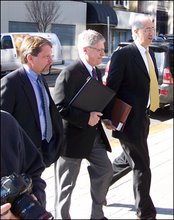
Short Title: LEO Provide Info to DA for Discovery.

(Public)

Sponsors:

Representatives Earle, Glazier, Harrison, Parmon (Primary Sponsors); Alexander, Brown, Cunningham, Hall, Insko, Lucas, Luebke, Wainwright, and Weiss.

Referred to:

Judiciary II.


March 15, 2007

A BILL TO BE ENTITLED

AN ACT to ensure district attorneys receive all necessary information from law enforcement agencies as recommended by the House interim study committee on capital punishment.

The General Assembly of North Carolina enacts:

SECTION 1. G.S. 15A‑903 reads as rewritten:

"§ 15A‑903. Disclosure of evidence by the State – Information subject to disclosure.

(a) Upon motion of the defendant, the court must order the State to:

(1) Make available to the defendant the complete files of all law enforcement and prosecutorial agencies involved in the investigation of the crimes committed or the prosecution of the defendant. The term "file" includes the defendant's statements, the codefendants' statements, witness statements, investigating officers' notes, results of tests and examinations, or any other matter or evidence obtained during the investigation of the offenses alleged to have been committed by the defendant. Oral statements shall be in written or recorded form. The defendant shall have the right to inspect and copy or photograph any materials contained therein and, under appropriate safeguards, to inspect, examine, and test any physical evidence or sample contained therein.

(2) Give notice to the defendant of any expert witnesses that the State reasonably expects to call as a witness at trial. Each such witness shall prepare, and the State shall furnish to the defendant, a report of the results of any examinations or tests conducted by the expert. The State shall also furnish to the defendant the expert's curriculum vitae, the expert's opinion, and the underlying basis for that opinion. The State shall give the notice and furnish the materials required by this subsection within a reasonable time prior to trial, as specified by the court.

(3) Give the defendant, at the beginning of jury selection, a written list of the names of all other witnesses whom the State reasonably expects to call during the trial. Names of witnesses shall not be subject to disclosure if the State certifies in writing and under seal to the court that to do so may subject the witnesses or others to physical or substantial economic harm or coercion, or that there is other particularized, compelling need not to disclose. If there are witnesses that the State did not reasonably expect to call at the time of the provision of the witness list, and as a result are not listed, the court upon a good faith showing shall allow the witnesses to be called. Additionally, in the interest of justice, the court may in its discretion permit any undisclosed witness to testify.

(b) If the State voluntarily provides disclosure under G.S. 15A‑902(a), the disclosure shall be to the same extent as required by subsection (a) of this section.

(c) A law enforcement agency shall make available to the State the complete files related to the investigation of the crimes committed or the prosecution of the defendant for compliance with this section and any disclosure under G.S. 15A‑902(a)."

SECTION 2. This act becomes effective December 1, 2007, and applies to cases where the trial date set pursuant to G.S. 7A‑49.4 is on or after that date.

Status:

History House Bill Action History
Date Action
03/14/2007 [H] Filed
03/15/2007 [H] Passed 1st Reading
03/15/2007 [H] Ref To Com On Judiciary II
05/02/2007 [H] Reptd Fav
05/02/2007 [H] Cal Pursuant Rule 36(b)
05/03/2007 [H] Placed On Cal For 5/7/2007

RSS Feed For Updates: Click Here.
SENATE BILL 1130

Short Title: Broaden Open Discovery.
(Public)

Sponsors:

Senator Clodfelter.

Referred to:

Judiciary I (Civil).


March 22, 2007

A BILL TO BE ENTITLED

AN ACT clarifying that defendants must have access to the complete files of all law enforcement and prosecutorial agencies in the open discovery process.

The General Assembly of North Carolina enacts:

SECTION 1. G.S. 15A‑903(a)(1) reads as rewritten:

"(1) Make available to the defendant the complete files of all law enforcement and prosecutorial agencies involved in the investigation of the crimes committed or the prosecution of the defendant. The term "file" includes the defendant's statements, the codefendants' statements, witness statements, investigating officers' notes, results of tests and examinations, or any other matter or evidence obtained during the investigation of the offenses alleged to have been committed by the defendant. The term "prosecutorial agency" includes any public or private entity that obtains information on behalf of a law enforcement agency or prosecutor in connection with the prosecution of the defendant. Oral statements shall be in written or recorded form. The defendant shall have the right to inspect and copy or photograph any materials contained therein and, under appropriate safeguards, to inspect, examine, and test any physical evidence or sample contained therein."

SECTION 2. This act becomes effective October 1, 2007.

Status:

History Senate Bill Action History
Date Action
03/20/2007 [S] Filed
03/22/2007 [S] Ref To Com On Judiciary I (Civil)

RSS Feed For Updates: Click Here.